17 September 2026
Mini Rice Mill for Home or Small Farm: Output, Power and Price
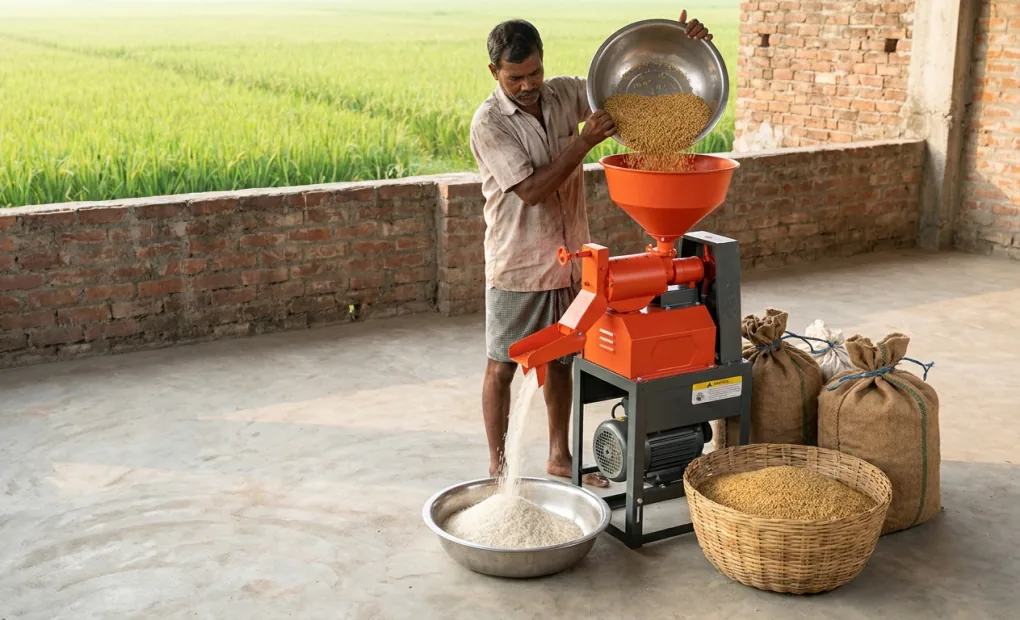
Many paddy growers sell their harvest or carry it to a mill in town, then pay for the milling, the transport and the wait. A mini rice mill brings that step home. You mill your own paddy when you need rice, keep the husk and bran, and can even offer milling to neighbours.
This guide explains what a mini rice mill is, how it works, how much rice you get from a quintal of paddy, whether it can run at home, and how to choose between the two ALAP models. Every specification and price below comes from the ALAP rice mills that Almighty Agrotech builds in Rajkot, so you can check each number against a real machine.
Quick answer: which mini rice mill should you buy?
For a family that mills its own paddy a few times a month, the ARM-6N-40 is enough. If you plan to mill for neighbours or run a small village milling service, the ARM-6N-100 gives more output per hour for ₹10,000 more. Both run on the same 3 HP electric motor or 7.5 HP petrol engine.
| Feature | ALAP ARM-6N-40 | ALAP ARM-6N-100 |
|---|---|---|
| Output | 165 to 200 kg per hour | 180 to 250 kg per hour |
| Power | 3 HP electric motor or 7.5 HP petrol engine | 3 HP electric motor or 7.5 HP petrol engine |
| Voltage | 220 V | 220 V |
| Spindle speed | 1,400 to 1,600 RPM | 1,400 to 1,600 RPM |
| Weight (without motor) | 23 kg | 29.5 kg |
| Packing size | 420 × 310 × 510 mm | 450 × 310 × 560 mm |
| Best for | Home use, small farms | Village milling, small commercial use |
| Price | ₹60,000 | ₹70,000 |
Prices are Almighty Agrotech website prices in September 2026, with free delivery across India. The product photos show each mill on its stand with an electric motor fitted. Confirm exactly what comes in the package, including motor and stand, with our team when you order.
What is a mini rice mill?
A mini rice mill turns paddy into rice in one compact machine. It removes the husk, the hard outer shell of the grain, and rubs off the outer bran layer so the rice comes out white. The ALAP mills also separate whole rice from broken rice in the same process.
A large commercial rice mill does the same work in several separate stages, with a dedicated rice huller, separators, polishers and graders, and handles tonnes an hour. A mini rice mill combines those steps into a single pass. It gives up some of that fine control in exchange for a price, size and power need that suit a home, a farm or a village.
How a mini rice mill works
- You pour cleaned, dry paddy into the hopper on top.
- A motor or engine drives the spindle at 1,400 to 1,600 RPM through a belt.
- Inside the milling chamber, a turning roller rubs the grains against each other and against the chamber wall, which strips off the husk and the bran.
- The husk and bran are separated from the grain, and the milled rice comes out of the outlet chute.
- On mills of this design, an adjusting wheel at the outlet controls how long the rice stays in the chamber, which changes how white it comes out.
Can you use a mini rice mill at home?
Yes. Both ALAP models are built for home use as well as small commercial work, and both run on a 220 V supply with a 3 HP electric motor. That makes them practical for a farmhouse, a courtyard or a small shed.
Check two things before you buy for home use. First, a 3 HP motor draws about 2.2 kW, so ask an electrician whether your connection's sanctioned load and wiring can carry it, and make sure the motor is properly earthed. Second, milling makes dust and noise, so a covered outdoor area or a separate room works better than inside the house.
Home milling makes the most sense when you grow paddy yourself. You mill in small batches when you need rice, it stays fresh, and you decide how much to polish it.
ARM-6N-40 vs ARM-6N-100: which one?
The two models share the same power, voltage and spindle speed. The difference is how much paddy they get through in an hour, and a small difference in size and weight.
ALAP ARM-6N-40
The ARM-6N-40 mills 165 to 200 kg of paddy an hour and weighs 23 kg without the motor. At ₹60,000 it suits a household or a small farm milling its own harvest, where an extra 50 kg an hour rarely matters.
ALAP ARM-6N-100
The ARM-6N-100 mills 180 to 250 kg an hour and weighs 29.5 kg without the motor. At ₹70,000 it is the better choice when the mill runs for several hours at a stretch, such as a milling service for other farmers, where the higher top output saves real time over a season.
A simple way to decide: if the machine will mostly sit idle between your own batches, buy the 6N-40. If you expect a queue of neighbours at harvest time, buy the 6N-100.
How much rice do you get from paddy?
The share of rice you get from paddy is called milling recovery. Our rice mill output calculator uses 66 percent as a typical figure. At that rate:
- 100 kg of paddy gives about 66 kg of rice and about 34 kg of husk and bran.
- 1,000 kg of paddy gives about 660 kg of rice.
- Time on the ARM-6N-40: 100 kg of paddy takes roughly 30 to 36 minutes at 165 to 200 kg per hour.
- Time on the ARM-6N-100: the same 100 kg takes roughly 24 to 33 minutes at 180 to 250 kg per hour.
Your real recovery depends on the paddy variety, how dry it is, how clean it is, and how much you polish. Well dried, clean paddy gives better recovery and fewer broken grains. Enter your own quantity and recovery in the calculator to plan a batch.
The by-products are useful too. Rice bran is widely fed to cattle and poultry, and rice husk is used as fuel and as bedding. If you also keep cattle, the paddy straw left after harvest can be cut for fodder with a chaff cutter, which our chaff cutter guide covers.
Electric motor or petrol engine?
Both ALAP mills can run on either power source. The choice comes down to where you mill.
3 HP electric motor
Choose the motor if you have a reliable 220 V supply where the mill will stand. It is quieter, needs no fuel and needs less servicing. A 3 HP motor uses about 2.2 units of electricity an hour at full load, so milling 100 kg of paddy uses roughly 1.1 to 1.4 units.
7.5 HP petrol engine
Choose an engine if power is missing or unreliable, or if you want to move the mill between villages. The mill's specification calls for 7.5 HP on petrol against 3 HP on electric, so do not fit a smaller engine to save money. It will slow down under load and mill unevenly. Almighty Agrotech also makes a 7.5 HP ALAP petrol engine.
What to check before you buy
- Your volume: estimate how much paddy you mill in a season and on your busiest day, then pick the model.
- The package: confirm whether the motor and stand are included, and what the delivery covers.
- Power supply: check sanctioned load, wiring and earthing for the 3 HP motor, or plan for the engine.
- Space: allow room around the mill for bags of paddy, rice, husk and bran, and for dust.
- Finance: if you are buying on a loan, work out the monthly payment with our farm machinery loan EMI calculator.
Is there a subsidy on mini rice mills?
Two routes are worth checking. The central PM Formalisation of Micro Food Processing Enterprises (PMFME) scheme offers a credit-linked capital subsidy of 35 percent of the eligible project cost, up to ₹10 lakh per unit, for micro food processing enterprises. Eligibility depends on your project, your district and the scheme rules at the time, so confirm with your district resource person or bank before you count on it.
Farm machinery subsidies through the Sub-Mission on Agricultural Mechanization and state agriculture departments differ by state and farmer category. Check the farm machinery subsidy portal, or use our Krishi Yantra subsidy checker to find the right link.
How to set up and run a mini rice mill
- Stand the mill on a firm, level floor and fix the stand so it cannot shift while running.
- Check belt tension and make sure every guard and cover is in place.
- For the electric motor, use proper wiring, a suitable switch and a good earth connection.
- Use well dried paddy, and clean out stones, straw and mud before it goes into the hopper.
- Start the mill empty, let it reach full speed, then feed paddy at a steady rate.
- Adjust the outlet a little at a time and check a handful of rice until the whiteness looks right.
- Switch the mill off completely before clearing any blockage, and keep hands away from moving parts.
Mini rice mill maintenance
- After every use: clean out husk, bran and grain left inside, so it does not cake and affect the next run.
- Belts: check for wear, cracks and slackness, and replace a worn belt before it slips.
- Wear parts: milling wears internal parts over time. Replace them when output drops or broken grains increase.
- Motor: keep it dry and free of dust, and do not let bran build up around the cooling fins.
- Servicing: follow the product manual's schedule, and contact our team for genuine parts.
Common mistakes with mini rice mills
- Milling damp paddy. It breaks easily and lowers your recovery. Dry it properly first.
- Skipping cleaning. Stones and mud damage the milling parts and spoil the rice.
- Overfeeding the hopper. Feeding faster than the mill can take strains the motor and mills unevenly.
- Over-polishing. Pushing for very white rice increases broken grains and turns more of your harvest into bran.
- Undersized power. A small engine or a weak supply slows the spindle and gives poor results.
- No earthing. A 3 HP motor without a proper earth is a shock risk, especially near water.
So which mini rice mill should you buy?
Start with how much paddy you mill and who you mill it for. A household or small farm milling its own harvest gets everything it needs from the ARM-6N-40. A farmer who wants to earn from milling other people's paddy should take the ARM-6N-100 for its higher output. Choose the 3 HP electric motor where you have steady power, and the 7.5 HP petrol engine where you do not.
Whichever you pick, dry and clean paddy, a steady feed and regular cleaning do more for rice quality than anything else.
Frequently asked questions
What is a mini rice mill?
A mini rice mill is a compact machine that turns paddy into rice in a single pass. It removes the husk and the outer bran layer, and the ALAP models also separate whole rice from broken rice. It suits homes, farms and small village milling units rather than large commercial rice mills.
What is the price of a mini rice mill in India?
Almighty Agrotech mini rice mills cost ₹60,000 for the ARM-6N-40 and ₹70,000 for the ARM-6N-100. These are website prices in September 2026 and include free delivery across India. Confirm what comes in the package, including motor and stand, when you order, and check the rice mill page for current prices.
How much rice can a mini rice mill produce per hour?
The ALAP ARM-6N-40 mills 165 to 200 kg of paddy an hour, and the ARM-6N-100 mills 180 to 250 kg an hour. At a typical 66 percent recovery, 200 kg of paddy gives about 132 kg of rice. Actual output depends on the paddy variety, moisture and how much you polish.
Can a mini rice mill run on home electricity?
Yes. Both ALAP models run on 220 V with a 3 HP electric motor. A 3 HP motor draws about 2.2 kW, so have an electrician confirm that your sanctioned load and wiring can handle it, and earth the motor properly. Where power is unreliable, a 7.5 HP petrol engine can drive the mill instead.
How much rice do you get from 100 kg of paddy?
At a typical milling recovery of 66 percent, 100 kg of paddy gives about 66 kg of rice, with the remaining 34 kg made up of husk and bran. Recovery changes with variety, dryness, cleanliness and polishing. Use our rice mill output calculator to estimate your own batch.
What is the difference between the 6N40 and 6N100 rice mill?
Both use a 3 HP electric motor or 7.5 HP petrol engine, run at 1,400 to 1,600 RPM on 220 V. The ARM-6N-40 mills 165 to 200 kg an hour and weighs 23 kg without the motor. The ARM-6N-100 mills 180 to 250 kg an hour and weighs 29.5 kg, which suits longer daily runs and milling for others.
Is there a subsidy for a mini rice mill?
Possibly. The PMFME scheme offers micro food processing enterprises a credit-linked capital subsidy of 35 percent of the eligible project cost, up to ₹10 lakh per unit, subject to eligibility. Farm machinery subsidies also vary by state. Check with your district office or bank, or use our Krishi Yantra subsidy checker.
Ready to choose? Compare the ARM-6N-40 and ARM-6N-100 with their current prices on our mini rice mill range, work out your batch with the rice mill calculator, or contact our team to confirm the package and delivery.
- 1. Quick answer: which mini rice mill should you buy?
- 2. What is a mini rice mill?
- 3. Can you use a mini rice mill at home?
- 4. ARM-6N-40 vs ARM-6N-100: which one?
- 5. How much rice do you get from paddy?
- 6. Electric motor or petrol engine?
- 7. What to check before you buy
- 8. Is there a subsidy on mini rice mills?
- 9. How to set up and run a mini rice mill
- 10. Mini rice mill maintenance
- 11. Common mistakes with mini rice mills
- 12. So which mini rice mill should you buy?
- 13. Frequently asked questions


