18 September 2026
How to Start an Agriculture Machinery Business in India: Dealership Guide
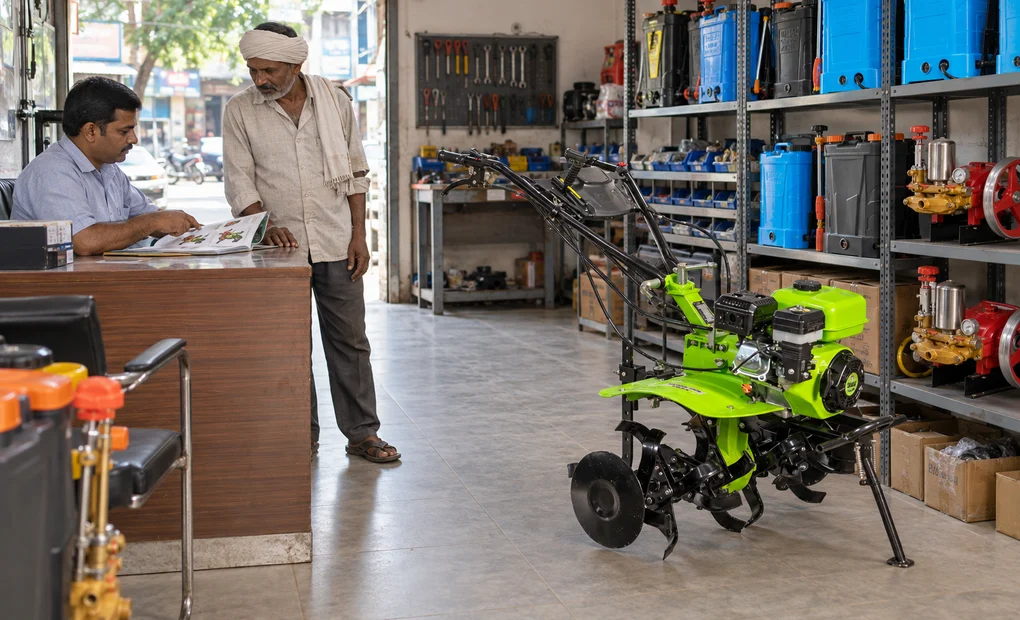
Every village that has moved from bullocks and hand pumps to power weeders, battery sprayers and brush cutters needs someone nearby who sells those machines, stocks the spare parts and fixes them in season. That local counter is the business this guide is about. If you are working out how to start an agriculture machinery business in India, the dealership model is the lowest-risk way in: you sell proven products from a manufacturer, and you earn on both the machine and everything that keeps it running.
This guide covers what drives demand, what you need before you open, how to judge a manufacturer, how margins, stock and after-sales fit together, and how to apply for an ALAP and MILAP dealership with Almighty Agrotech. It is written for shop owners, agri input retailers and anyone planning a farm equipment dealership, not for farmers buying a single machine.
Already running an agro business and ready to talk? Apply for an ALAP and MILAP dealership and our team will contact you within five to seven working days.
Why farm machinery retail is growing
Indian farming is still only partly mechanised, and that gap is the opportunity. According to the Ministry of Agriculture, the average level of farm mechanisation in India is about 45 percent. It is highest for seed-bed preparation at 70 percent, but only 40 percent for sowing and planting, 33 percent for weeding and inter-culture, and 34 percent for harvesting and threshing. Those low numbers are exactly the operations that power weeders, brush cutters and sprayers serve.
Government support is pushing machines into more villages every year:
- Subsidy on machines: under the Sub-Mission on Agricultural Mechanization, farmers get financial assistance of 40 to 50 percent of the cost of machinery, depending on their category.
- Scale of the scheme: between 2014-15 and 2025-26, the Centre released ₹9,404.47 crore to states, 21,61,202 machines were distributed on subsidy to individual farmers, and 27,554 Custom Hiring Centres and 25,608 Farm Machinery Banks were set up, according to PIB.
- Lower tax on machinery: GST on agricultural machinery was cut from 12 and 18 percent to 5 percent from 22 September 2025, which brings down the price farmers pay.
For a dealer, that means steady demand from three kinds of buyer: individual farmers using subsidy, Custom Hiring Centres buying several machines at once, and farmers replacing manual work in weeding, spraying and cutting.
What you need to start an agriculture machinery business
A farm equipment dealership is a retail and service business. The machine brings the customer in once. Spares, repairs and the next machine bring them back. Plan for both from day one.
A location farmers already visit
The best counters sit where farmers already come to spend money: near the mandi, on the main road into town, or beside seed, fertiliser and pesticide shops. A farmer buying inputs for the season is already thinking about spraying and weeding. Being two doors away is worth more than a cheaper rent on a quiet street.
Space for display, stock and service
- Display: room to show a power weeder, a brush cutter and a few sprayers assembled, so customers can see and handle them.
- Storage: dry, lockable space for boxed stock, plus shelving for spare parts sorted by model.
- Service bench: a workbench, basic tools and an area where engines can be started and tested safely.
Working capital
The capital you need depends on the categories you stock, how deep you go in each, and your town's buying season, so there is no single right figure. Budget for four things: opening machine stock, a spare parts inventory, a few display and demo units, and room to carry stock through the weeks before peak season. Discuss the opening stock for your market directly with the manufacturer during onboarding rather than guessing.
Registrations
- GST registration: done on the GST portal. Manufacturers invoice dealers business to business, so a GSTIN is essential. For an Almighty Agrotech dealership, a valid 15-digit GST number is a mandatory field on the application.
- Udyam registration: free, paperless MSME registration on the Ministry of MSME's Udyam portal. Retail and wholesale traders are eligible to register.
- Shop and establishment registration: required under your state's law, through the state labour department or local body.
- Trade licence: check with your municipality or panchayat, since local rules differ.
People
You need at least one person who can demonstrate machines confidently and one who can service them. Farmers buy from the counter that can start the engine, show the attachment change and fix a sprayer that will not build pressure. Manufacturer training closes most of that gap quickly.
Picking a brand: what to check in a manufacturer
The brand you sign with decides your margins, your stock risk and your reputation for years. Check these before you commit.
- Manufacturer or trader: a company that builds its own machines can supply spare parts and technical help directly. A trader or importer often cannot.
- Certification: ISI (BIS) marking and FMTTI testing show that products meet government standards.
- Spare parts supply: ask which parts are made in-house and how quickly they reach dealers. A machine that waits weeks for a washer costs you the customer.
- Warranty handling: find out who verifies claims, how long replacement takes, and whether dealers are part of the process.
- Range across seasons: a range that covers spraying, weeding, cutting, fodder and water lets you sell all year instead of for two months.
- Territory: ask how area protection works and how many dealers already serve your district.
- Dealer support: product training, marketing material, branding for your shop and a named contact for problems.
- Brand pull: ask farmers and mechanics in your area which names they already trust. Selling a known brand is faster than building one.
Margins and inventory basics
Dealer margins differ by product category, brand and volume, and change with schemes, so confirm the dealer price, MRP and any seasonal schemes in writing before you place your first order. What you can control is how much of that margin you keep, and that comes down to inventory.
- Stock to the season: sprayer demand peaks ahead of and during the spraying season, power weeders and attachments around land preparation and intercultivation, and chaff cutters where dairy farmers need fodder. Build stock a few weeks before each peak, not during it.
- Start narrow, then widen: open with the categories your area buys most, then add lines once you see what moves.
- Keep fast movers deep: popular sprayer models and common spare parts should never run out in season.
- Avoid dead stock: review slow items every month and ask the manufacturer about your options before they age on the shelf.
- Sell at MRP with confidence: a printed MRP, a demo and a clear warranty process sell better than discounting.
After-sales: spare parts and service as a revenue line
A machine sale happens once. The same farmer needs washers, nozzles, blades, belts and a service every season for years. Dealers who treat after-sales as a business, not a favour, build steady income between machine seasons and keep customers from drifting to the next town.
- Spare parts counter: stock the parts that fail most often for every model you sell. Our spray pump spare parts name list shows which sprayer parts wear out first.
- Service jobs: charge for pre-season servicing, engine tuning and repairs. Farmers pay for a machine that works on the day they need it.
- Warranty desk: handling claims well builds trust. Under Almighty Agrotech's return and replacement policy, approved pickups are often routed through the nearest authorised dealer, which keeps the customer coming to your counter.
- Repeat sales: a farmer happy with a sprayer comes back for a power weeder, a brush cutter or power weeder attachments.
Almighty Agrotech supplies genuine parts from its spare parts range to appointed dealers, so routine repairs happen at your counter instead of at the factory.
Why dealers choose ALAP and MILAP
Almighty Agrotech Pvt. Ltd. has manufactured agricultural equipment in Rajkot, Gujarat since 1977. Here is what that means for a dealer.
- Manufacturer, not a trader: every machine is built at the company's own plant at Lodhika GIDC, Metoda, Rajkot, which is what makes direct spare part supply and factory technical support possible.
- Certified quality: ISI (BIS) and FMTTI certification, and an ISO 9001 certified company.
- A proven network: 3,000+ authorised dealers across India and more than 1 crore customers.
- A range for every season: 50+ products across power weeders, battery sprayers, manual sprayers, power sprayers, HTP sprayers, brush cutters, chaff cutters, rice mills, water pumps, engines, attachments, spray guns and spare parts.
- Two brands from one supplier: ALAP and MILAP cover different models and price points, so one account serves a wider range of buyers.
- Spare parts made in-house: supplied to appointed dealers so fast-moving parts stay on your shelf.
- Dealer support: product training, marketing materials, branding support and technical assistance.
- Existing dealers welcome: if you already sell other farm equipment brands, your customer base and service knowledge count in your favour.
If that fits your business, apply for an Almighty Agrotech dealership today.
How to apply for an ALAP and MILAP dealership
- Get your GST certificate ready. A valid 15-digit GST number is mandatory. If your registration is still in process, wait until it is issued.
- Fill in the dealership inquiry form. It asks for your full name, mobile number, email address, business or shop name, GST number, city and state, current business type, years in business, and whether you already deal in similar products.
- Add the details that help us judge the fit. Mention the categories you sell today and the villages or taluka your counter serves.
- Wait for our team to contact you. We review every inquiry and normally contact you within five to seven working days.
- Discuss onboarding. Product categories for your market, area protection, opening stock and training are agreed at this stage. Area protection depends on market potential, existing coverage and performance.
Prefer to talk first? Call customer care on 02827-287307 or 02827-287407, call +91 99792 55149, or contact us online.
Common mistakes new dealers make
- Stocking everything at once. Start with what your area buys and expand from sales data.
- Ignoring spare parts. Without parts on the shelf, every breakdown sends a customer elsewhere.
- Buying stock during the peak. By then you are too late. Order ahead of the season.
- No demo units. Farmers want to see a machine start and work before they pay for it.
- Competing only on price. Service, parts and a working warranty desk win repeat business. Discounts do not.
- Signing without checking territory. Ask how many dealers already serve your area before you commit.
Frequently asked questions
How do I start an agriculture machinery business in India?
Choose a location near where farmers already buy inputs, register for GST, arrange display, storage and service space, and partner with a manufacturer that supplies spare parts and training. A dealership lets you sell proven machines instead of building a brand from scratch, and after-sales service adds steady income between seasons.
Do I need GST registration for a farm equipment dealership?
Yes. Manufacturers invoice dealers business to business, so you need a GSTIN. For an Almighty Agrotech dealership, a valid 15-digit GST number is a mandatory field on the inquiry form. If your registration is still in process, wait until it is issued before you apply.
How much investment does an agriculture machinery dealership need?
It depends on the categories you stock, the depth of your opening stock, your spare parts inventory and your local buying season, so there is no fixed figure. Opening stock and categories for your market are discussed with our team during onboarding, which gives you a realistic plan before you commit money.
Can I apply if I already sell other farm equipment brands?
Yes, and it usually helps. The application asks whether you already deal in similar products, because an existing machinery counter has the customer base, display space and service knowledge a new dealership needs. Tell us what you handle today so the fit can be judged properly.
How long does dealership approval take?
Once you submit the inquiry, our team reviews your details and normally contacts you within five to seven working days. Categories, area protection and opening stock are then discussed during onboarding.
Will I get area protection as a dealer?
Area protection is considered based on market potential, existing coverage and performance, and is discussed during onboarding. Applications from markets that are not yet covered typically move faster than those from areas that are already well served.
Does Almighty Agrotech supply spare parts to dealers?
Yes. Spare parts are manufactured in-house alongside the machines and supplied to appointed dealers, so you can keep fast-moving parts on your shelf and complete routine repairs at your counter. Technical assistance from the factory is available when a repair needs it.
Ready to build a farm equipment business with a manufacturer that has backed dealers since 1977? Apply for an ALAP and MILAP dealership and our team will be in touch.
- 1. Why farm machinery retail is growing
- 2. What you need to start an agriculture machinery business
- 3. Picking a brand: what to check in a manufacturer
- 4. Margins and inventory basics
- 5. After-sales: spare parts and service as a revenue line
- 6. Why dealers choose ALAP and MILAP
- 7. How to apply for an ALAP and MILAP dealership
- 8. Common mistakes new dealers make
- 9. Frequently asked questions


