21 August 2026
Agriculture Spray Pump Spare Parts Name List (With Diagram)
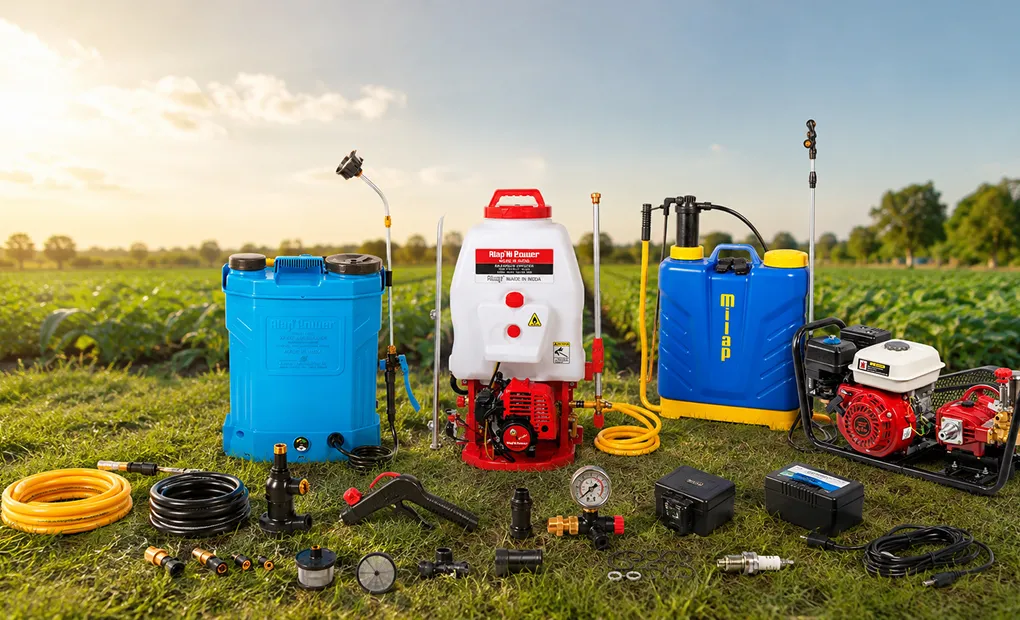
Your sprayer stops building pressure in the middle of a cotton field. The spray turns into a dribble. You know something inside has worn out, but when you reach the dealer counter you cannot name the part, so you end up describing it with your hands and hoping he understands.
That guessing game is what this guide ends.
Below is a complete agriculture spray pump spare parts name list covering all four sprayer types used on Indian farms: battery sprayers, manual and knapsack sprayers, power sprayers, and HTP sprayers. For every part you get the correct name, what it actually does, and the warning signs that tell you it needs replacing. Save this page or take a screenshot to the shop. Ask for the part by name and you will get the right one the first time.
Almighty Agrotech has been building plant protection equipment in Rajkot since 1977, and our ALAP and MILAP sprayers are serviced through more than 3,000 dealers across India. The part names used here are the ones dealers actually recognise.
How a spray pump works
Every sprayer, whatever the type, does the same three jobs. It holds liquid in a tank. It builds pressure through a pump. It releases that liquid as a fine spray through a nozzle.
Almost every sprayer fault traces back to one of those three stages:
- Tank side problems: leaks, cracks, a blocked strainer
- Pump side problems: worn seals, damaged plungers, faulty valves
- Nozzle side problems: blocked tips, worn orifices, missing washers
Once you know which stage is failing, finding the part becomes simple. That is why the lists below are grouped by sprayer type and then by section.
Battery sprayer spare parts name list
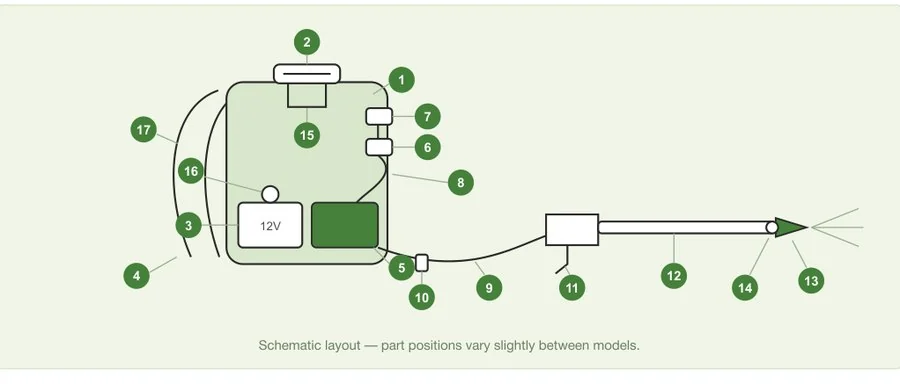
Battery sprayers are the most common machine on small and mid size farms today. A 12V battery drives a small pump, so there is no hand pumping. Fewer moving parts than a power sprayer, but the electrical side brings its own wear points.
|
# |
Part name |
What it does |
Replace when |
|
1 |
Tank (16L HDPE) |
Holds the spray solution |
Cracks, hairline leaks near the base |
|
2 |
Tank lid with washer |
Seals the tank opening |
Liquid seeps out when you bend forward |
|
3 |
12V battery |
Powers the motor |
Backup drops well below a full day of work |
|
4 |
Battery charger |
Recharges the battery |
Charging light does not turn on or hold |
|
5 |
Motor pump (single or double) |
Builds spray pressure |
Runs but pressure stays weak, or gets very hot |
|
6 |
Pressure switch |
Cuts the motor when the trigger closes |
Motor keeps running with trigger released |
|
7 |
On/off switch |
Main power control |
Loose, sparks, or does not hold position |
|
8 |
Wiring harness |
Connects battery, switch and motor |
Burnt smell, exposed copper, melted insulation |
|
9 |
Delivery hose pipe |
Carries liquid to the lance |
Cracks, hardening, leaks at bends |
|
10 |
Hose clamp |
Grips the hose at each joint |
Rusted or unable to tighten |
|
11 |
Trigger cut off valve |
Starts and stops the spray |
Drips after release, stiff trigger |
|
12 |
Lance or spray rod |
Extends your reach into the crop |
Bent, leaking at the joint |
|
13 |
Nozzle set |
Shapes the spray pattern |
Uneven pattern, wider droplets than before |
|
14 |
Nozzle washer and O ring |
Seals the nozzle to the lance |
Dripping at the nozzle head |
|
15 |
Tank strainer or filter |
Stops dirt entering the pump |
Torn mesh, or you find grit inside the tank |
|
16 |
Suction filter |
Protects the pump inlet |
Pressure drops even with a full tank |
|
17 |
Shoulder straps |
Carry the load on your back |
Fraying, broken buckle |
Watch how these parts fit together before you order anything. This assembly video shows the full battery sprayer build, step by step:
https://youtube.com/shorts/0JJ-Q4PIfRU
For 2 in 1 battery sprayers, which run on both battery and manual pumping, you also get a manual pump lever, piston washer and connecting rod. Those follow the manual sprayer list in the next section. Here is what a 2 in 1 unit includes out of the box:
https://youtube.com/shorts/iS7hmis4Qtw
Manual and knapsack sprayer spare parts name list
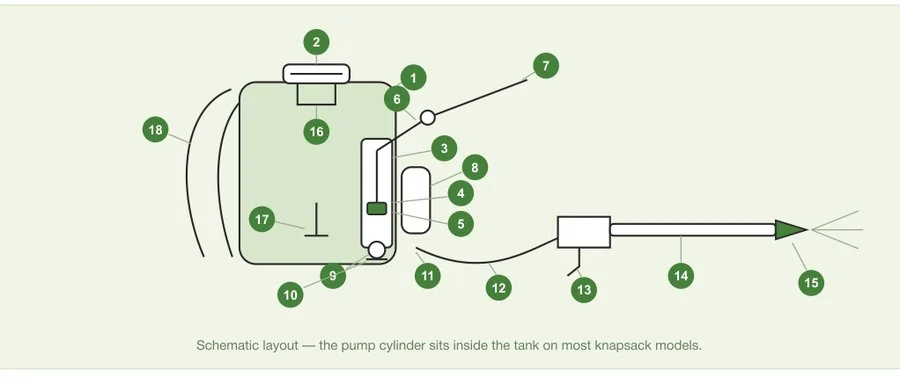
Manual sprayers keep working when there is no charge, no fuel and no power supply. That reliability comes from a simple mechanical pump, and mechanical pumps wear at predictable points.
|
# |
Part name |
What it does |
Replace when |
|
1 |
Tank |
Holds the solution |
Cracks or leaks at the seam |
|
2 |
Tank lid and gasket |
Seals the top |
Spillage while walking |
|
3 |
Pump cylinder |
Houses the piston |
Scored inside wall, pressure loss |
|
4 |
Piston or plunger |
Pushes liquid under pressure |
Pumping feels loose and easy |
|
5 |
Piston washer or cup seal |
Creates the pressure seal |
Most common failure part, see below |
|
6 |
Connecting rod |
Links handle to piston |
Bent or has play at the joints |
|
7 |
Handle or lever |
You pump with this |
Cracked weld, loose pivot pin |
|
8 |
PVC pressure chamber |
Smooths pressure between strokes |
Spray pulses instead of running steady |
|
9 |
Non return valve ball |
Stops backflow |
Liquid pushes back into the tank |
|
10 |
Valve seat |
Seats the ball tightly |
Ball no longer seals, weak pressure |
|
11 |
O rings and gasket kit |
Seal every joint |
Leaks anywhere along the pump body |
|
12 |
Delivery hose |
Carries liquid to the lance |
Cracks, splits at the clamp |
|
13 |
Trigger cut off valve |
Controls the spray |
Continuous drip |
|
14 |
Lance or extension rod |
Reach into the crop |
Bent, threads worn |
|
15 |
Nozzle |
Forms the spray pattern |
Coarse droplets, uneven fan |
|
16 |
Strainer |
Filters the solution |
Torn mesh |
|
17 |
Agitator |
Keeps the mix even |
Broken paddle |
|
18 |
Shoulder straps |
Carry the tank |
Fraying, broken hook |
Foot sprayers add a foot rest, foot lever and a suction hose with foot valve. Rocker sprayers add a rocker arm, a rocker stand and a longer suction hose with a strainer at the end. Still choosing between the three? Our knapsack vs foot vs rocker sprayer comparison covers price, hose reach and the crops each one suits.
The piston washer is the single part farmers replace most often on a manual sprayer. It is cheap, it takes minutes to change, and worn washers are behind most complaints about a knapsack sprayer that "will not build pressure." Keep two spares in your tool bag through the spraying season.
See how a knapsack sprayer is put together and used in the field:
https://youtube.com/shorts/niw6aJdm8aU
Power sprayer spare parts name list
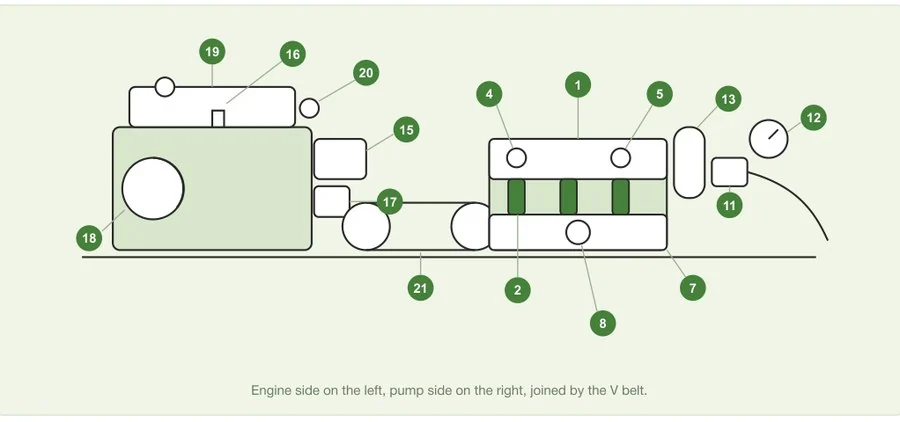
Power sprayers run on a 2 stroke or 4 stroke petrol engine driving a plunger pump. That gives you far higher pressure and coverage, and it means you are maintaining two machines in one: an engine and a pump. The lists below are separate for that reason.
Pump side parts
|
# |
Part name |
What it does |
Replace when |
|
1 |
Pump head or body |
Houses the pumping assembly |
Cracks, persistent seepage |
|
2 |
Plunger set (3 piston) |
Creates the pressure |
Scoring or scratches on the surface |
|
3 |
Plunger seal and packing |
Seals each plunger |
Water dripping from under the pump head |
|
4 |
Suction valve assembly |
Draws liquid in |
Pump struggles to prime |
|
5 |
Delivery valve assembly |
Pushes liquid out |
Pressure gauge swings up and down |
|
6 |
Valve spring |
Returns the valve |
Weak or broken spring, unstable pressure |
|
7 |
Crankcase |
Holds the drive assembly |
Oil leaks, cracked casing |
|
8 |
Crankshaft |
Converts rotation to stroke |
Play or knocking noise |
|
9 |
Connecting rod |
Drives the plungers |
Noise under load |
|
10 |
Oil seal |
Keeps pump oil in |
Oil on the outside of the crankcase |
|
11 |
Pressure regulator or unloader |
Sets your working pressure |
Pressure cannot be adjusted |
|
12 |
Pressure gauge |
Shows the pressure |
Needle stuck or reads zero under load |
|
13 |
Air chamber |
Steadies the flow |
Spray pulses badly |
|
14 |
Gasket kit |
Seals every joint |
Any joint that seeps after tightening |
Engine side parts
|
# |
Part name |
What it does |
Replace when |
|
15 |
Air filter |
Keeps dust out of the engine |
Visibly clogged, engine loses power |
|
16 |
Spark plug |
Ignites the fuel |
Hard starting, black or oily tip |
|
17 |
Carburettor |
Mixes air and fuel |
Rough idle, will not hold speed |
|
18 |
Recoil starter |
Starts the engine |
Rope frayed, spring will not return |
|
19 |
Fuel tank and cap |
Holds petrol |
Cracks, leaking cap seal |
|
20 |
Fuel filter |
Cleans the fuel |
Fuel starvation under load |
|
21 |
V belt and pulley |
Transfers engine power to pump |
Slipping, glazing, cracks |
Hose and spray parts
Suction hose with strainer, high pressure delivery hose, hose clamps, spray gun, brass lance, nozzle set and nozzle washers. On long hose runs, check the clamps at both ends first when pressure drops. It is a faster fix than opening the pump.
Full fitting and live testing of a 4 stroke power sprayer, showing where each of these sits on the machine:
https://youtube.com/shorts/FeVzQUD_j7g
HTP sprayer spare parts name list
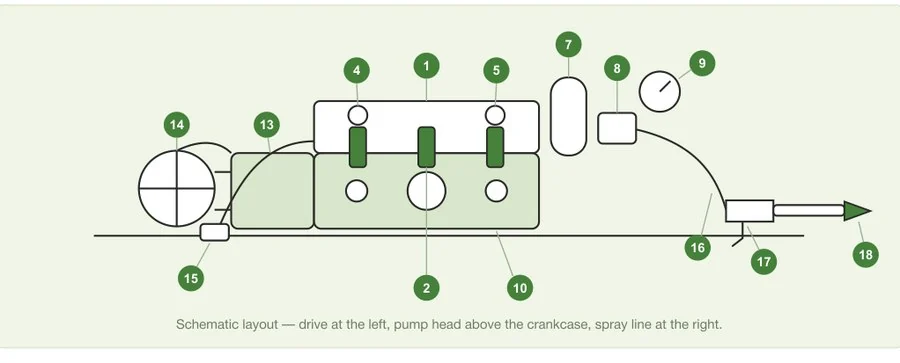
HTP stands for horizontal triplex plunger. These are the high pressure pumps used for orchards, cotton, and any tall crop where the spray has to reach the top canopy. They are built heavier than power sprayers and are usually driven by an electric motor, an engine or a tractor PTO. Common sizes are 22 and 30.
|
# |
Part name |
What it does |
Replace when |
|
1 |
HTP pump head |
Main pumping body |
Cracks, seepage that tightening will not stop |
|
2 |
Ceramic plunger set |
Builds high pressure |
Chipped, scored or dull surface |
|
3 |
Plunger packing or seal |
Seals each plunger |
Water weeping below the head, the classic HTP fault |
|
4 |
Suction valve |
Draws solution in |
Slow or failed priming |
|
5 |
Delivery valve |
Sends solution out |
Pressure fluctuation |
|
6 |
Valve seat and spring |
Seats and returns the valve |
Pitted seat, weak spring |
|
7 |
Air chamber or pressure vessel |
Absorbs pressure shock |
Heavy pulsing at the gun |
|
8 |
Pressure regulator |
Sets the working pressure |
Pressure will not hold steady |
|
9 |
Pressure gauge |
Displays pressure |
Needle stuck or damaged glass |
|
10 |
Crankcase and crankshaft |
Drive assembly |
Knocking, excess play |
|
11 |
Bearing set |
Supports the crankshaft |
Noise, heat, roughness when turned by hand |
|
12 |
Oil seal |
Retains crankcase oil |
Oil traces outside the case |
|
13 |
Gear box |
Steps down the drive speed |
Noise, oil leak |
|
14 |
V belt and pulley |
Power transfer |
Slipping, cracked belt |
|
15 |
Suction pipe with foot valve |
Draws from tank or drum |
Loses prime, torn strainer |
|
16 |
High pressure delivery hose |
Carries the spray |
Bulges, cracks, leaking at the ferrule |
|
17 |
Spray gun and brass lance |
Directs the spray |
Leaks at the trigger, worn threads |
|
18 |
Nozzle set |
Shapes the pattern |
Coarse droplets, poor top canopy reach |
Ceramic plunger packing is the part to know on an HTP pump. When you see water weeping from below the pump head, replace the packing set early. Running it in that condition lets water reach the crankcase oil, and then a small part replacement turns into a full pump overhaul.
Assembly and operation of an ALAP and MILAP HTP power sprayer:
https://youtube.com/shorts/zRlAxv4ycE8
Parts that wear out fastest
Across every sprayer type, the same short list accounts for most breakdowns. Keep these in your shed before the spraying season starts, not after your machine stops:
1. Nozzle set and nozzle washers
2. Piston washer or cup seal on manual sprayers
3. Plunger packing on power and HTP pumps
4. O rings and the full gasket kit
5. Delivery hose and hose clamps
6. Trigger cut off valve
7. Strainer and suction filter
8. Battery and charger on battery sprayers
9. Air filter and spark plug on engine driven sprayers
Nozzles deserve a special mention. They wear invisibly. The orifice widens slowly with use, and your sprayer keeps working, so nothing looks wrong. But a worn nozzle puts out more liquid in coarser droplets, which means you are using more chemical and getting worse coverage.
Check your nozzles against a new one at the start of every season. Our guide to spray pump nozzle types explains which pattern suits which crop.
Genuine parts vs local parts
A local copy of a piston washer costs less at the counter. Whether it costs less over a season is a different question.
The parts where the difference shows up quickly:
- Seals, packing and O rings. Material quality decides how long they hold pressure against agrochemicals. Poor rubber swells or hardens within weeks.
- Ceramic plungers. A slightly out of spec plunger chews through packing sets and can damage the pump head.
- Nozzles. Orifice accuracy is the whole product. A nozzle machined loosely sprays an uneven pattern from day one.
- Motors and pressure switches on battery sprayers. Undersized windings run hot and fail early.
Parts where a good quality local option is usually acceptable: hose clamps, shoulder straps, tank lids and general fasteners.
Almighty equipment is ISI marked under the Bureau of Indian Standards and FMTTI certified, which means the machines have been tested by government institutes. Those tested tolerances only hold if the internal parts match the original specification. You can check what BIS certification covers on the Bureau of Indian Standards website, and read about machinery testing at the Farm Machinery Training and Testing Institute.
How to order the right spare part
Have these four things ready and the process takes two minutes:
1. Sprayer type. Battery, manual, power or HTP.
2. Model number. Printed on the machine label, for example APB, MPS-4, AHP-4S, ATP-22.
3. Part name. Use the exact name from the tables above.
4. A photo. Send a picture of the worn part alongside the machine label.
WhatsApp all four to +91 99097 88770 and you will get confirmation of the correct part along with the current rate. If you would rather buy over the counter, any of our 3,000 plus dealers can supply ALAP and MILAP spares. Browse the full range on our spare parts page.
One habit worth building: write your model number inside the shed door on a piece of paper the day the machine arrives. Machine labels fade after a few seasons in the sun, and a faded label is what turns a two minute parts order into a two day one.
Get the right part the first time
Print this list, save it to your phone, or take a screenshot of the table that matches your sprayer. Knowing the part name is most of the battle at the dealer counter.
Almighty Agrotech has manufactured plant protection equipment in Rajkot since 1977. ISI marked, FMTTI certified, Made in India, and backed by over 3,000 dealers and 1 crore plus customers.
Need a part today? WhatsApp the part name and your model number to +91 99097 88770, or call 02827-287307.
Run a power weeder too? Its clutch cables, pistons, blades and transmission parts are on the same spare parts page, and you can compare current models on our power weeder price list.
Explore battery sprayers, power sprayers, manual sprayers and HTP sprayers, or find your nearest dealer on our contact page.
Frequently Ask Questions
What are the main parts of an agriculture spray pump?
Every spray pump has a tank, a pump assembly, a delivery hose, a trigger cut off valve, a lance and a nozzle. Beyond that the parts depend on type. Battery sprayers add a battery, charger, motor and pressure switch. Manual sprayers add a piston, piston washer and pressure chamber. Power and HTP sprayers add plungers, packing, valves and an engine or motor drive.
Which spray pump part fails most often?
Seals. On manual sprayers it is the piston washer, on power and HTP pumps it is the plunger packing. Both are inexpensive and quick to change, and both cause the same complaint of low or falling pressure. Nozzles are second, though they wear slowly enough that most farmers never notice until coverage has already dropped.
Why does my spray pump not build pressure?
Check in this order. Is the tank strainer or suction filter blocked? Is the piston washer or plunger packing worn? Is a hose clamp loose or a hose cracked? Is the non return valve seating properly? Is the nozzle worn wider than it should be? Nine out of ten pressure complaints are solved somewhere in that list.
How often should I replace sprayer nozzles?
Compare your nozzles to a new one at the start of each spraying season. If output has increased noticeably at the same pressure, or the spray pattern looks uneven or streaky, replace the set. Nozzles are the cheapest part on the machine and the one with the biggest effect on how much chemical you use.
Can I use spare parts from another brand in my ALAP sprayer?
Some general items such as hose clamps and straps are interchangeable. Pressure parts are not. Plungers, packing, valves and seals are machined to model specific tolerances, and a part that is close but not correct wears out fast and can damage the pump body around it. Always match the part to your model number.
Do you supply spare parts at wholesale rates?
Yes. Battery sprayer parts, power sprayer pump parts, HTP parts and brush cutter blades are available at wholesale rates for dealers and retailers. If you are an agri retailer looking to stock ALAP and MILAP spares, apply for a dealership or send your requirement on WhatsApp.
What does HTP stand for in HTP pump?
Horizontal triplex plunger. Three plungers arranged horizontally, which produces the steady high pressure needed for orchards and tall crops. Sizes are commonly listed as 22 and 30, referring to the pump capacity rating.
Download the full parts list
The same list in one printable file: every part on a battery, manual, power and HTP sprayer, with a labelled diagram for each machine, what each part does and the sign that tells you it needs replacing. Seven pages, free, no sign up. Download the spray pump spare parts name list (PDF).
- 1. How a spray pump works
- 2. Battery sprayer spare parts name list
- 3. Manual and knapsack sprayer spare parts name list
- 4. Power sprayer spare parts name list
- 5. HTP sprayer spare parts name list
- 6. Parts that wear out fastest
- 7. Genuine parts vs local parts
- 8. How to order the right spare part
- 9. Get the right part the first time
- 10. Frequently Ask Questions
- 11. Download the full parts list
Need help choosing the right spare parts for your farm? Send your details and our team will get back to you with prices and your nearest dealer.
View the Spare Parts range →


