17 September 2026
HTP Sprayer Pump Guide: How It Works, 22 vs 30 L/min and Price
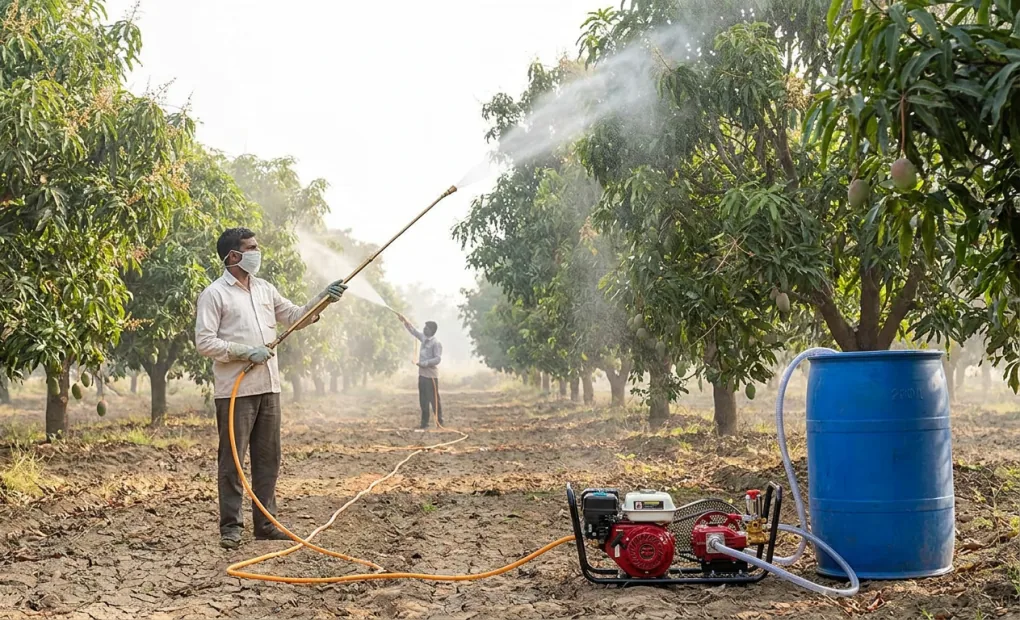
A portable power sprayer does a good job on a few acres of vegetables. Take it into a mango orchard or a large pomegranate block and the limits show up fast: the 20 L tank empties every few minutes, one person carries the weight, and the spray fades before it reaches the top of the canopy. That is the job an HTP sprayer pump is built for.
This guide explains what an HTP sprayer pump is, how it works, how it differs from a portable power sprayer, and how to choose between a 22 and a 30 L/min pump, an engine set or a pump on its own. Every specification and price below comes from the ALAP HTP range that Almighty Agrotech builds in Rajkot, so you can check each number against a real machine.
Quick answer: which HTP setup should you buy?
If you already own an engine or electric motor of the right size, buy the pump unit alone. Choose the ATP-22 when two people spray at a time, and the ATP-30 when three people spray at once. If you are starting from nothing, buy a complete set, which comes with the engine, suction hose and spray gun already matched to the pump.
| Model | What you get | Flow | Spray lines | Power needed | Price |
|---|---|---|---|---|---|
| ALAP HTP ATP-22 | Pump unit only | 22 L/min | 2 | 2 to 5 HP | ₹7,000 |
| ALAP HTP ATP-30 | Pump unit only | 30 L/min | 3 | 3 HP | ₹10,000 |
| ALAP HTP Complete Set AHC-22a | Pump with 6 HP 4-stroke petrol engine, 2.5 m suction hose, 24 inch gun | 22 L/min (30 L/min option) | 2 or 3 | Engine included | ₹35,000 |
| ALAP HTP Complete Set AHC-22-30 | Pump with 3.5 HP Briggs & Stratton XR550 engine, 2.5 m suction hose, 24 inch gun | 22 or 30 L/min | 2 or 3 | Engine included | ₹35,000 |
Prices are Almighty Agrotech website prices in September 2026, with free delivery across India.
What is an HTP sprayer pump?
HTP stands for horizontal triplex plunger. Inside the pump body, three plungers lie flat side by side and push liquid out one after another, so the delivery never drops to zero between strokes. That steady push is what keeps pressure even at the gun when two or three people spray from the same pump. It works on the same principle as any plunger pump, built heavy enough to run for hours in the field.
You will see HTP written as "high pressure type" on some dealer pages. The name refers to the pump design, and the three plungers are what the word triplex means.
An HTP pump has no tank and no engine of its own. It sits on the ground or on a trolley, draws spray solution from a drum through a suction hose, and sends it out through long delivery hoses to one, two or three spray guns.
How an HTP sprayer pump works
- An engine or electric motor turns a belt and pulley, which drives the crankshaft inside the pump.
- The crankshaft moves the three stainless steel plungers back and forth in turn.
- On each backward stroke, a plunger pulls solution in from the drum through the suction hose and strainer.
- On each forward stroke, it pushes that solution out through the delivery valve at 30 to 35 kg/cm².
- On a typical HTP pump, an air chamber smooths out the pulses and a pressure regulator lets you set the working pressure.
- The solution travels through the delivery hose, up to 100 m long, to the spray gun.
For scale, 30 to 35 kg/cm² works out to roughly 430 to 500 psi. That is enough to push spray to the top of a mature orchard tree from the ground.
HTP pump parts at a glance
- Pump head and plungers: build the pressure. ALAP ATP pumps use three stainless steel plungers.
- Plunger packing and seals: seal each plunger. Water weeping below the pump head means they need replacing.
- Suction and delivery valves: let solution in and push it out in one direction only.
- Crankcase, crankshaft and bearings: the drive side, running in oil.
- Air chamber, pressure regulator and gauge: keep the spray steady and show the working pressure.
- Suction hose with strainer, delivery hose and spray gun: connect the drum to the person spraying.
Our spray pump spare parts name list covers every HTP part, what it does and when to replace it.
HTP sprayer vs portable power sprayer
Many buyers assume an HTP sprayer is chosen for higher pressure. On the ALAP range that is not the difference. The ALAP Hi Power portable sprayers and the ALAP HTP pumps are both rated at 30 to 35 kg/cm². What changes is how much liquid the pump moves, how many people it feeds, and where the liquid sits.
| Feature | Portable power sprayer (ALAP AHP-4S) | HTP sprayer (ALAP ATP-22 or ATP-30) |
|---|---|---|
| Working pressure | 30 to 35 kg/cm² | 30 to 35 kg/cm² |
| Flow | 10.5 L/min | 22 or 30 L/min |
| Spray lines | 1 | 2 or 3 at once |
| Where the liquid sits | 20 L tank on your back | Drum or tank on the ground |
| Power | 31 cc 4-stroke engine on the frame | Separate engine or electric motor, 2 to 6 HP |
| Best for | Vegetables, small orchards, one operator | Large orchards, plantations, cotton, contract spraying |
| Price | ₹18,000 | ₹7,000 to ₹10,000 for the pump, ₹35,000 as a complete set |
In practice, the portable sprayer moves with you. The HTP pump stays in one place while the hose moves. On a large block, that means you refill a 200 L drum instead of a 20 L tank, and two or three people spray at the same time from one pump.
Between the two sits the ALAP APH-4S, a portable engine pump without a tank that also runs a delivery line up to 100 m at 10.5 L/min. It suits a single operator who wants long reach without buying a full HTP setup.
22 vs 30 L/min: which HTP pump size?
The number on an HTP pump is its suction capacity, the litres per minute it can draw. Both ALAP pumps build the same 30 to 35 kg/cm² and support a 100 m delivery line. The real question is how many spray guns you want running together.
ALAP ATP-22
The ATP-22 draws 22 L/min, runs two delivery lines at once and turns at 800 to 1,200 RPM. It needs 2 to 5 HP to drive it. At ₹7,000 it suits a family orchard or a farm where two people usually spray together.
ALAP ATP-30
The ATP-30 draws 30 L/min, runs up to three delivery lines and turns at 800 to 1,000 RPM. It needs 3 HP. At ₹10,000 it is the pump for plantations, large orchards and anyone doing contract spraying, where a third gun finishes the block sooner.
A simple way to decide: count the people who will spray at the same time on a normal day. Two people means the ATP-22. Three means the ATP-30. If you only ever spray alone, a portable power sprayer will cost less to run.
Engine, electric motor or complete set?
An HTP pump needs something to turn it. You have three practical options.
A complete set with engine
This is the easiest start. The ALAP HTP Complete Set AHC-22a pairs the pump with a 6 HP 4-stroke petrol engine (model 168F, 3,600 RPM, 4.6 kW) that uses about 800 to 1,000 ml of petrol an hour. It comes with a 2.5 m suction hose and a 24 inch spray gun. It is built around the 22 L/min pump, with a 30 L/min option available.
The ALAP HTP Complete Set AHC-22-30 uses a 3.5 HP Briggs & Stratton XR550 4-stroke engine instead, with a choice of 22 or 30 L/min pump. It weighs 28.1 kg and is the choice if you want a Briggs & Stratton engine for servicing reasons. Both sets cost ₹35,000.
Neither set lists a delivery hose, so plan the hose length for your farm and confirm it with our team when you order.
A pump unit on your own engine
If you already own a stationary petrol or diesel engine of the right power, the ATP-22 or ATP-30 alone saves money. Match the engine to the pump's power need: 2 to 5 HP for the ATP-22, 3 HP for the ATP-30.
Speed matters as much as power. An engine turns at around 3,600 RPM, while the pump is rated for 800 to 1,200 RPM (ATP-22) or 800 to 1,000 RPM (ATP-30). The belt and pulley sizes bring the speed down, so choose the pulleys to keep the pump inside its rated range.
A pump unit on an electric motor
Where spraying happens close to a power supply, such as a nursery, a greenhouse block or a farm with a pump house near the orchard, an electric motor removes fuel cost and engine servicing. The same power and RPM rules apply. The trade-off is that you are tied to the power point, so the hose has to do all the travelling.
Where an HTP sprayer makes sense
- Orchards and tall trees: mango, pomegranate, citrus and similar crops where the spray has to reach the top of the canopy.
- Plantations: long rows where moving a portable sprayer and refilling a small tank wastes the day.
- Cotton and large field crops: big areas where two or three sprayers working together cut the days spent spraying.
- Nurseries: fixed spraying positions with power nearby.
- Contract spraying and service stations: ALAP HTP pumps are also rated for service station use, such as washing.
To estimate how much area one drum covers at your spray rate, try our sprayer tank coverage calculator.
How to set up and run an HTP sprayer
- Place the pump level on firm ground or a trolley, close to the drum.
- Check the pump crankcase oil. Both ALAP complete sets specify 20W40 for the HTP pump.
- Check the belt tension and make sure the belt guard is in place.
- Fit the strainer on the suction hose and drop it fully into the drum, below the liquid level.
- Connect the delivery hose and spray gun, and tighten every joint.
- Set the pressure regulator low, then start the engine or motor.
- Point the gun away from people, open it, and let air clear from the line.
- Raise the pressure slowly to the level your crop needs, and watch the gauge.
HTP pump maintenance
- After every use: run clean water through the pump, hoses and gun for a few minutes. Chemical left inside eats the seals and packing.
- Oil: check the crankcase oil level before each spraying day. Milky oil means water has got past the packing.
- Packing: replace plunger packing as soon as water starts weeping below the pump head. Waiting lets water into the oil and turns a cheap repair into a full overhaul.
- Strainer and nozzles: clean them after each session so grit does not reach the valves.
- Storage: drain the pump and hoses and keep the unit dry and covered between seasons.
Genuine seals, valves and hoses are available in our spare parts range.
Common mistakes with HTP sprayers
- Buying a pump without matching the engine. An underpowered engine stalls when the third gun opens.
- Running the pump too fast. Wrong pulley sizes push the pump past its rated RPM and wear the packing early.
- Skipping the strainer. Sand and leaf bits from the drum damage the valves.
- Running the pump dry. Stop before the drum empties, or the packing heats up.
- Using the wrong nozzle. A jet nozzle reaches tall trees, while a cone nozzle suits closer foliage. Our guide to spray pump nozzle types explains each one.
- Spraying without protection. Spray at this pressure travels far and drifts. Wear gloves, a mask, eye protection and full sleeves, and follow personal protective equipment guidance and the dose on the chemical label.
Is there a subsidy on HTP sprayers?
Sprayers can qualify for farm machinery subsidies in India, which run through the central Sub-Mission on Agricultural Mechanization and state agriculture departments. Which models qualify, and for how much, differs by state and farmer category. Check the farm machinery subsidy portal or your state portal before you buy, or use our Krishi Yantra subsidy checker to find the right link.
So which HTP sprayer should you buy?
Start with the number of people who spray together. Two people and a large orchard need an ATP-22. Three people, a plantation or contract work need an ATP-30. If you have no engine yet, the complete set is simpler than matching one yourself, and you can pick the 6 HP petrol set or the Briggs & Stratton set.
If you spray alone on a few acres, an HTP pump is more machine than you need. A portable power sprayer delivers the same pressure with less setup. For small plots and spot spraying, see our comparison of knapsack, foot and rocker sprayers.
Frequently asked questions
What is the full form of HTP in an HTP sprayer?
HTP stands for horizontal triplex plunger. The pump has three plungers laid flat side by side, and they push liquid out one after another to give steady high pressure. It has no tank or engine of its own. An engine or electric motor drives it, and it draws spray solution from a drum through a suction hose.
What is the difference between an HTP sprayer and a power sprayer?
On the ALAP range, both work at 30 to 35 kg/cm², so pressure is not the difference. A portable power sprayer carries a 20 L tank on your back and delivers 10.5 L/min to one gun. An HTP pump draws 22 or 30 L/min from a drum on the ground and feeds two or three guns at once, which suits large orchards and plantations.
What is the difference between a 22 and a 30 HTP pump?
The number is the suction capacity in litres per minute. The ALAP ATP-22 draws 22 L/min, runs two delivery lines and needs 2 to 5 HP. The ATP-30 draws 30 L/min, runs up to three delivery lines and needs 3 HP. Both deliver 30 to 35 kg/cm² and support a 100 m delivery line.
How much HP engine is needed for an HTP pump?
The ALAP ATP-22 needs 2 to 5 HP and the ATP-30 needs 3 HP. The ALAP complete sets use a 6 HP petrol engine or a 3.5 HP Briggs & Stratton XR550 engine. Speed matters too. The ATP-22 runs at 800 to 1,200 RPM and the ATP-30 at 800 to 1,000 RPM, so the belt and pulleys must bring the engine speed down to that range.
What is the price of an HTP sprayer pump in India?
Almighty Agrotech HTP pump units cost ₹7,000 for the 22 L/min ATP-22 and ₹10,000 for the 30 L/min ATP-30. Complete sets with an engine, suction hose and spray gun cost ₹35,000. These are website prices in September 2026 and include free delivery across India. Check the HTP sprayer page for current prices.
Which oil should I use in an HTP pump?
Both ALAP HTP complete sets specify 20W40 oil for the HTP pump crankcase. Check the level before each spraying day. If the oil looks milky, water is getting past the plunger packing, so replace the packing before running the pump again.
Can three people spray from one HTP pump?
Yes, with the right pump. The ALAP ATP-30 supports up to three delivery lines at the same time, and the ATP-22 supports two. Each line can run up to 100 m, so a team can cover a large orchard block without moving the pump.
Ready to choose? Compare the ATP-22, ATP-30 and both complete sets with their current prices on our HTP sprayer range, pick a matching gun from the Hi-Jet spray gun and lance range, or contact our team for help sizing your setup.
- 1. Quick answer: which HTP setup should you buy?
- 2. What is an HTP sprayer pump?
- 3. HTP sprayer vs portable power sprayer
- 4. 22 vs 30 L/min: which HTP pump size?
- 5. Engine, electric motor or complete set?
- 6. Where an HTP sprayer makes sense
- 7. How to set up and run an HTP sprayer
- 8. HTP pump maintenance
- 9. Common mistakes with HTP sprayers
- 10. Is there a subsidy on HTP sprayers?
- 11. So which HTP sprayer should you buy?
- 12. Frequently asked questions


