26 September 2026
Power Weeder Spare Parts Name List (With Diagram)
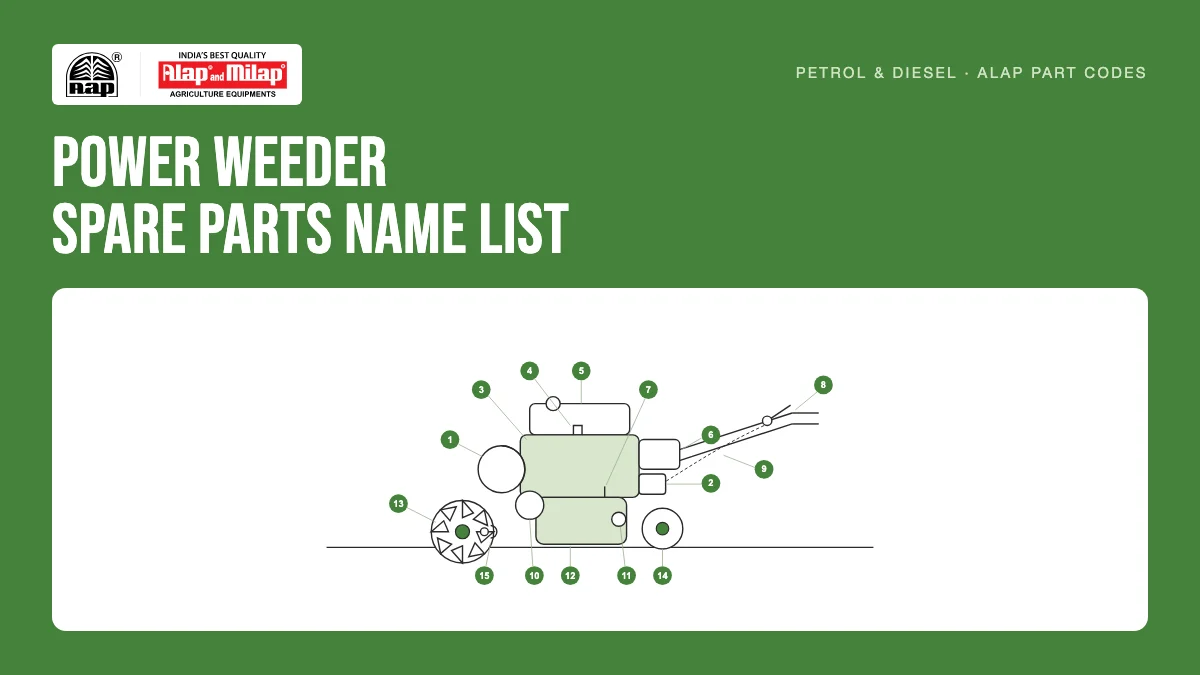
You are halfway down a row, the tiller is biting well, and then the blades stop pulling. The engine is still running. Something between the engine and the blades has given up. You take the machine to the dealer, and the first question is the one you cannot answer: which part?
This guide is the answer to that question.
Below is a complete power weeder spare parts name list, split the way the machine is actually built: engine side, transmission side, tilling side, and the cables you hold in your hands. Petrol and diesel models are listed separately, because they do not share their fuel system parts. For every part you get the name a dealer recognises, what it does, and the sign that tells you it is finished.
The last section carries the real ALAP part codes. If you can quote a code, you skip the guessing entirely.
Almighty Agrotech has been manufacturing farm machinery in Rajkot since 1977. Our ALAP and MILAP power weeders are serviced through more than 3,000 dealers across India, and the part names and codes below are the ones those dealers stock.
How a power weeder works
Whatever the model, a power weeder does three things in sequence. An engine makes power. A clutch and gearbox carry that power down to the blades. The rotary blades cut and turn the soil while the wheels and handle keep the machine tracking straight.
Nearly every breakdown sits in one of those three stages:
- Engine side: hard starting, loss of power, fuel not reaching the cylinder
- Transmission side: engine runs but the blades will not turn, or will not stop
- Tilling side: blades turn but the machine will not dig, or digs unevenly
Work out which stage has failed before you open anything. A machine that runs perfectly but does not till has nothing wrong with its engine, and a clutch cable costs a fraction of what a day of wrong dismantling costs you.
Engine side parts, petrol models
Petrol power weeders such as the APW-100P and the MILAP range use a single cylinder petrol engine with a recoil starter. These are the parts that wear.
|
Part name |
What it does |
Replace when |
|
Recoil starter |
Cranks the engine when you pull the rope |
Rope frayed, spring will not pull the rope back in |
|
Carburettor |
Mixes petrol with air in the right ratio |
Rough idle, will not hold speed, floods on starting |
|
Carburettor packing |
Seals the carburettor to the engine so it draws no stray air |
Engine races on its own, or dies when warm |
|
Piston |
Compresses the charge and takes the combustion force |
Compression gone, heavy smoke, scoring on the skirt |
|
Spark plug |
Fires the fuel at the right moment |
Hard starting, black or oily tip, cracked insulator |
|
Fuel tank |
Holds the petrol |
Cracks, rust inside, cap seal no longer holding |
|
Air filter |
Keeps field dust out of the cylinder |
Visibly clogged, or the engine loses power under load |
The air filter is the cheapest part on this table and the one that decides how long the piston lasts. Tilling throws dust straight up into the machine. Clean it at the end of every working day in dry conditions, not once a season.
Engine side parts, diesel models
Diesel models such as the APW-105DE and APW-105DM have no spark plug and no carburettor at all. Fuel is injected under pressure instead, so the wear points are different.
|
Part name |
What it does |
Replace when |
|
Fuel injection valve assembly |
Sprays diesel into the cylinder as a fine mist |
White smoke, knocking, engine will not take load |
|
Fuel pump |
Builds the pressure the injector needs |
Hard starting, power falls away as the tank empties |
|
Fuel pipe |
Carries diesel from tank to pump |
Hardening, cracks at the bends, air being drawn in |
|
Gear oil dipstick |
Lets you check the gearbox oil level |
Lost or bent, so the level can no longer be read |
A diesel that starts hard is almost always a fuel delivery problem, not a battery or a compression problem. Work backwards from the injector: pipe, then pump, then injector.
Transmission and drive parts
This is the section most farmers arrive at, because it is where the complaint "engine runs but the blades will not turn" is solved.
|
Part name |
What it does |
Replace when |
|
Clutch friction plate |
Grips and releases engine power to the gearbox |
Blades turn weakly under load, or burning smell while tilling |
|
Clutch lever cable |
Carries your hand movement to the clutch |
Stretched, frayed strands, clutch will not fully disengage |
|
Reverse cable |
Engages reverse drive |
Reverse will not engage, or will not release |
|
Transmission gearbox oil seal |
Keeps gear oil inside the box and soil outside it |
Oil film on the housing, or oil level dropping between services |
|
Box housing packing |
Seals the joint faces of the gearbox housing |
Seepage from the joint line that tightening will not stop |
Gearbox oil leaks are worth treating as urgent. The seal itself is a small part. A gearbox run dry because nobody replaced it is not.
Tilling and wheel parts
|
Part name |
What it does |
Replace when |
|
Tilling blade |
Cuts weeds and turns the soil |
Edges rounded, blades shortened by wear, bent after hitting stone |
|
Tyre assembly |
Carries and steers the machine between rows |
Tread worn smooth, sidewall cracked, rim damaged |
|
Round head pin |
Holds blade sets and attachments in position |
Bent, worn thin, or no longer a tight fit |
|
R pin |
Locks the pin so it cannot work loose in the field |
Sprung open, lost tension, or missing |
Worn blades are the quietest problem on this list. The machine still runs, still sounds right, and still moves down the row, so nothing seems wrong. What changes is depth: rounded blades skid over hard ground instead of biting into it, and you end up making two passes where one used to do. Keep one new blade aside and compare against it at the start of the season.
Carry spare R pins in the tool kit. They cost almost nothing, they are the part most often lost in the soil, and without one you cannot safely refit a blade set in the field.
ALAP power weeder part codes
These are the codes our dealers order against. Quote the code and the model together and there is nothing left to describe.
|
Code |
Part |
Fits |
|
PW-05 |
Round head pin 8 x 50 mm |
Common |
|
PW-10 |
R pin 9 x 2 x 38 mm |
Common |
|
PW100P-36 |
Clutch lever cable without handle |
Petrol |
|
PW100P-44 |
Carburettor packing |
Petrol |
|
PW100P-55 |
Piston |
Petrol |
|
PW100P-62 |
Spark plug |
Petrol |
|
PW100P-65 |
Fuel tank |
Petrol |
|
PW100P-76 |
Carburettor |
Petrol |
|
PW100P-88 |
Transmission gearbox oil seal 25 x 47 x 7 |
Petrol |
|
PW100P-112 |
Recoil starter |
Petrol |
|
PW100P-122 |
Reverse cable |
Petrol |
|
PW100P-138 |
Box housing packing |
Petrol |
|
PW100PA-02 |
Tyre assembly |
Petrol |
|
PW105DE-04 |
Gear oil dipstick |
105DE / 135DE |
|
PWDE/DM-18 |
Fuel pipe 7.4 x 13.50 |
Diesel |
|
PWDE/DM-19 |
Fuel injection valve assembly |
Diesel |
|
PWDE/DM-107 |
Fuel pump |
Diesel |
|
PW100P/DM-04 |
Tool kit box |
100P / DM |
|
PW100P/DM-08A |
Clutch friction plate |
APW-100P / DM |
|
PW100P/DE-13 |
Tilling blade |
100P / DE |
Read the codes and the fitment becomes obvious. A code starting PW100P belongs to the petrol machine. PWDE or PWDM belongs to the diesel machines. PW on its own, like the pins, fits across the range.
Parts that wear out fastest
Across every power weeder, a short list accounts for most of the downtime. Keep these before the season, not after the machine stops in the middle of it:
- Air filter, and a spark plug on petrol machines
- Tilling blades, and the pins and R pins that hold them
- Clutch lever cable
- Clutch friction plate on machines that have done heavy hours
- Gearbox oil seal and box housing packing
- Fuel pipe, on diesel and petrol alike
- Recoil starter rope
How to order the right part
Four things get you the correct part on the first attempt:
- Find the model on the machine plate. APW-100P, APW-105DE, APW-105DM and the MILAP models do not share every part
- Know whether your machine is petrol or diesel. This decides the entire fuel system list
- Use the part name from this page, and the code from the table above where you have it
- For pumps, gearboxes and clutch assemblies, confirm fitment before ordering rather than assuming that a part fits every machine in the range
If you are unsure, send us the model and a description of what the machine is doing wrong. Our team will tell you which part you need and which dealer near you stocks it, whether or not you bought the machine from us.
Frequently asked questions
Are power weeder and power tiller parts the same?
The two machines share the same working principle and many of the same part names, but the parts themselves are sized to each machine. Order against your own model number rather than against the machine type.
Do petrol and diesel power weeders share spare parts?
They share the pins, blades and many transmission parts, but nothing in the fuel system. A diesel machine has an injector and a fuel pump where a petrol machine has a carburettor and a spark plug.
How often should tilling blades be replaced?
There is no fixed interval, because it depends entirely on your soil. Stony and hard ground wears blades several times faster than soft soil. Judge by depth: when the machine needs two passes where it used to need one, the blades have lost their edge.
My engine runs but the blades do not turn. Which part is it?
Start with the clutch lever cable, which is the cheapest and the most common cause. If the cable is sound and correctly adjusted, the clutch friction plate is next.
Can I get parts for an older ALAP power weeder?
Availability depends on the model and the part. Send us your model number and we will confirm what is still available.
Download the full parts list
Same list, printable, with the labelled diagram and the ALAP part codes included. Take it to the dealer counter instead of describing the part with your hands. Download the power weeder spare parts name list (PDF).
- 1. How a power weeder works
- 2. Engine side parts, petrol models
- 3. Engine side parts, diesel models
- 4. Transmission and drive parts
- 5. Tilling and wheel parts
- 6. ALAP power weeder part codes
- 7. Parts that wear out fastest
- 8. How to order the right part
- 9. Frequently asked questions
- 10. Download the full parts list


