24 August 2026
Best Battery Sprayer for Agriculture in India: How to Choose
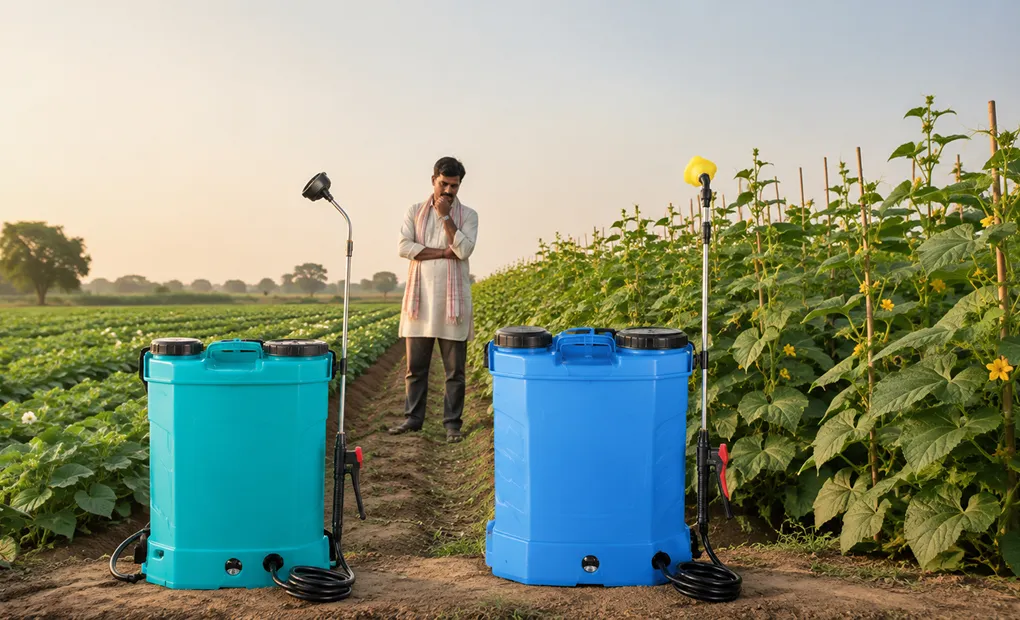
Ask ten dealers which is the best battery sprayer for agriculture and nine will point at the double motor model. More pressure, higher price, must be better.
Check the actual numbers and it falls apart. The ALAP APS single motor sprays 560 to 640 litres on one charge. The APS-11 double motor sprays 400 to 450 litres on the same 12V battery. The double gives you more pressure and 200 fewer litres of work.
Neither is wrong. They are built for different farms. The problem is that nobody explains the trade before you pay.
This guide answers the four questions that actually decide which sprayer you should buy: single or double motor, how far one charge goes, what tank size your back can handle, and which model fits your crop. Every figure comes from published ALAP and MILAP specifications, not estimates. When you are ready to buy, the full range sits on our battery sprayers page.
How does a battery sprayer pump work?
A 12V rechargeable battery drives a diaphragm pump. The pump pulls solution from the tank and pushes it out through the lance and nozzle under pressure. No hand pumping, no fuel, no engine noise.
The pumps in this range are auto cut-off type. Release the trigger and the pump stops instead of straining against a closed valve. That saves battery and stops the pump overheating, which is the fastest way to kill a cheap sprayer.
Three numbers decide what any battery sprayer can do for you:
1. Pressure in PSI. How hard the spray comes out and how far it reaches.
2. Litres per charge. How much solution you can spray before recharging.
3. Tank capacity. How often you stop to refill.
Everything below is those three numbers applied to real decisions.
https://youtube.com/shorts/0JJ-Q4PIfRU
Single motor or double motor battery sprayer: which should you buy?
Shops say "double motor". Spec sheets say "double diaphragm pump". Same machine, and this is the decision most buyers get wrong.
|
Single motor |
Double motor |
|
|
Pressure |
100 PSI |
110 PSI |
|
Litres per charge |
448 to 640 L |
400 to 450 L |
|
Reach |
Standard |
Higher, better for tall crops |
|
Battery drain |
Lower |
Higher |
|
Price |
From ₹3,500 |
From ₹5,000 |
A double diaphragm pump draws more current to make more pressure. More current from the same 12V battery means fewer litres before recharging. You are trading coverage for force.
When to choose a single motor battery sprayer
Buy single motor if you grow field crops at normal height: cotton, groundnut, pulses, vegetables. You want area covered between charges, not extra pressure you will never use. The APS covers 560 to 640 litres per charge, the highest in the range.
When to choose a double motor battery sprayer
Buy double motor if you need reach: taller crops, dense canopy, or hi-jet gun work where pressure does the job. The APS-11 and MPS-5 both run a 110 PSI double diaphragm pump and both include a hi-jet gun.
A farmer with three acres of cotton and a farmer with an orchard need different machines. Buying the expensive one by default usually means charging twice a day for pressure the crop did not need.
Why every model here is a knapsack battery sprayer
Knapsack means the tank sits on your back on shoulder straps rather than being wheeled or hand carried. That is the standard format for Indian field conditions, where you walk between rows rather than drive along them.
How many acres does a battery sprayer cover in one charge?
Every listing tells you the tank size. Almost none tell you how far a charge actually goes. Here are the published figures, converted into something you can plan a working day around.
|
Model |
Litres per charge |
Tank |
Tank loads per charge |
Approx. acres per charge |
|
APS |
560 to 640 L |
16 L |
35 to 40 |
About 4 acres |
|
MPS-4 |
448 to 480 L |
16 L |
28 to 30 |
About 3 acres |
|
APS-11 |
400 to 450 L |
18 L |
22 to 25 |
Under 3 acres |
|
MPS-5 |
400 to 450 L |
20 L |
20 to 22 |
Under 3 acres |
|
MPS-3 |
350 to 400 L |
16 L |
22 to 25 |
2 to 2.5 acres |
How to read the acres figure for your crop
The acres column assumes about 150 litres of solution per acre, a common rate for field crops at mid growth. Your real figure moves with crop, growth stage, nozzle and walking speed. Early stage spraying uses far less water per acre, so the same charge stretches further. A dense canopy at flowering uses more.
The tank loads column is straight arithmetic from the published litres and involves no assumption at all.
For most small and mid size farms, one full charge covers a working day. Charge overnight, start every morning full.
What tank size battery sprayer do you need: 16L, 18L or 20L?
Bigger is not automatically better. A full 16 litre tank already puts over 16 kg on your back before you count the machine.
1. 16 litres is the standard and suits most farmers. APS, MPS-3 and MPS-4 use it.
2. 18 litres on the APS-11 means fewer refill stops for slightly more weight.
3. 20 litres on the MPS-5 is the largest here. Worth it if refilling is the slow part of your day and you can carry the load.
Think about where your water is. If the borewell sits at the edge of a large plot, a bigger tank saves real walking. If water is close, a smaller tank keeps you fresher through the afternoon.
Tanks in this range use PPCP virgin material, which stands up to agrochemicals better than recycled plastic.
What is a 2 in 1 battery sprayer?
A 2 in 1 runs on battery and switches to a manual handle when the charge runs out. You keep spraying instead of walking back to charge.
Worth the small extra cost if power supply where you spray is unreliable, or if you occasionally need a longer day than one charge allows. The MPS-3 at ₹3,500 is the cheapest way into the range and still includes 4 nozzle types and a telescopic lance. The APS-6 is the ALAP version.
https://youtube.com/shorts/iS7hmis4Qtw
Battery sprayer vs manual vs power sprayer
|
Battery sprayer |
Manual sprayer |
Power sprayer |
|
|
Effort |
Low, no pumping |
High, constant pumping |
Low |
|
Pressure |
100 to 110 PSI |
Depends on your pumping |
Highest |
|
Running cost |
Charging only |
None |
Petrol |
|
Coverage |
2 to 4 acres per charge |
Limited by stamina |
Largest |
|
Best for |
Small and mid farms |
Small plots, backup |
Large farms, orchards |
|
Needs |
Charging point |
Nothing |
Fuel and servicing |
Battery sprayers sit in the middle for a reason. They remove the fatigue of hand pumping without the fuel cost and servicing of an engine. For most Indian farms under five acres, that is the right trade.
Keep a manual sprayer as backup even after buying a battery unit. It works when there is no power and costs very little. Our knapsack vs foot vs rocker sprayer guide helps you pick the right one. For larger holdings and orchards, a power sprayer is the better tool.
Which nozzle to use with your battery sprayer?
The nozzle decides your spray pattern, droplet size and how much chemical you actually use. Most models here ship with more than one.
1. Flower type multi-hole (4 holes) for broad coverage over a crop canopy
2. Fan flat type for even band coverage along rows
3. Hi-jet gun on double motor models, for distance and tall crops
4. Mist nozzle on the MPS-2, for fine droplet application
The APS and MPS-4 include 4 nozzle types. The MPS-5 includes 3 types plus a hi-jet gun. Match the nozzle to the job rather than using whichever one happens to be fitted.
When to replace a worn nozzle
Nozzles wear invisibly. The orifice widens with use, output rises, droplets coarsen, and you spend more on chemical for worse coverage. Compare yours against a new one each season. Our guide to spray pump nozzle types covers which pattern suits which crop.
Best battery sprayer models: ALAP and MILAP compared
|
Model |
Range |
Tank |
Pump |
Per charge |
Price |
|
ALAP POWER |
16 L |
100 PSI auto cut-off |
560 to 640 L |
₹4,000 |
|
|
APS-6 |
ALAP 2 in 1 |
Check page |
Check page |
Check page |
₹5,000 |
|
ALAP Double POWER |
18 L |
110 PSI double |
400 to 450 L |
₹6,000 |
|
|
APB |
ALAP Portable |
Check page |
110 PSI double |
400 to 450 L |
₹6,000 |
|
MPS |
MILAP POWER |
Check page |
Check page |
Check page |
₹4,000 |
|
MPS-2 |
MILAP Mist |
Check page |
Check page |
Check page |
₹4,500 |
|
MILAP 2 in 1 |
16 L |
100 PSI auto cut-off |
350 to 400 L |
₹3,500 |
|
|
MILAP VIRAT |
16 L |
100 PSI auto cut-off |
448 to 480 L |
₹4,000 |
|
|
MILAP DOUBLE |
20 L |
110 PSI double |
400 to 450 L |
₹5,000 |
|
|
MILAP VISTA |
Check page |
Check page |
Check page |
₹4,000 |
Battery sprayer price in this range runs ₹3,500 to ₹6,000. Rates shown are current listed prices and change with offers. For a full breakdown of what sets the price across tank sizes and motors, see our battery sprayer price guide.
Pick by what you need:
1. Most ground covered per charge: APS, 560 to 640 litres
2. Pressure with a large tank: MPS-5, 110 PSI and 20 litres
3. Lowest price, and a 2 in 1: MPS-3 at ₹3,500
4. Easiest to carry all day: APB, built around a lightweight 1 foot spray gun
Compare all models side by side on the battery sprayers page.
Battery sprayer maintenance: how to make it last
1. Battery sprayers fail for boring reasons, and every one of them is avoidable.
2. After every use. Run clean water through the pump and lance for a minute. Chemical left inside dries in the diaphragm and nozzle. That is what kills pumps.
3. Battery care. Charge fully rather than topping up in short bursts, and do not leave it flat for weeks in the off season. Give it a full charge once a month when the sprayer is idle. Batteries in this range are maintenance free, so there is no water to check.
4. Before storage. Empty the tank, wash it, dry it, and store with the lid loose so it does not trap moisture.
5. Each season. Check nozzle wear, hose cracks, the trigger cut-off valve, the tank strainer, and the wiring for burnt smell or exposed copper.
Everything on that list is stocked through the dealer network. Our spray pump spare parts name list gives you the correct name for each part, and the spare parts page has the range.
Making the decision
Start with the crop, not the price tag. Field crops at normal height: single motor, and take the extra litres. Tall or dense crops: double motor, and accept fewer litres per charge. Then pick the tank size your back can carry through an afternoon.
Almighty Agrotech has manufactured plant protection equipment in Rajkot since 1977. ISI marked, FMTTI certified, Made in India, and backed by over 3,000 dealers and 1 crore plus customers.
WhatsApp +91 99097 88770 or call 02827-287307 for the best price on any model.
See the full battery sprayer range, or apply for a dealership if you want to stock ALAP and MILAP. New to it? Read the agriculture machinery dealership guide.
Frequently ask questions
Which is the best battery sprayer for agriculture in India?
For most farmers, a 16 litre single motor model, because it balances coverage, weight and price. The ALAP APS at ₹4,000 delivers the highest litres per charge in the range at 560 to 640 litres. If you grow tall or dense crops and need pressure, the MPS-5 pairs a 110 PSI double motor with a 20 litre tank at ₹5,000.
Which is better, single motor or double motor battery sprayer?
Depends on your crop, not on price. Single motor gives more litres per charge at 100 PSI, so you cover more ground before recharging. Double motor gives 110 PSI for better reach on tall or dense crops but sprays 400 to 450 litres per charge instead of up to 640. Field crops usually suit single motor. Orchards and hi-jet gun work suit double.
How many acres can a battery sprayer cover in one charge?
Roughly 2 to 4 acres depending on model and water rate per acre. The ALAP APS covers 560 to 640 litres per charge, which at about 150 litres per acre works out near 4 acres. At early growth stages you use less water per acre, so the same charge covers more ground.
How long does a battery sprayer take to charge?
Charging time depends on the battery capacity and the charger supplied with your model. Follow the instructions in your product manual, charge fully rather than partially, and disconnect once the charger shows a full charge. Overcharging shortens battery life more than anything else.
What is the difference between a 12Ah and 8Ah battery?
Ah means amp hours, which is how much charge the battery holds. A 12Ah holds more than an 8Ah, so it sprays more litres before recharging. Some models such as the APS and MPS-3 are offered with either. If you regularly spray more than an acre at a time, the 12Ah is worth it.
Can I use a battery sprayer for fertilizer as well as pesticide?
Yes. These handle pesticide, herbicide and liquid fertilizer. Wash the tank, hose and nozzle thoroughly between different chemicals, especially after herbicide, because residue can damage a crop even in small amounts.
What does ISI marking on a sprayer mean?
ISI is the certification mark of the Bureau of Indian Standards, meaning the product is made to a published Indian standard and the factory is audited for it. Almighty equipment is also tested by the Farm Machinery Training and Testing Institute, a government body that puts agricultural machines through standardised field and lab testing. On a sprayer this matters most for tank material, pressure rating and build consistency.
Do battery sprayer spare parts fit across brands?
Rarely. Pumps, pressure switches, nozzles and seals are built to model specifications. A part that is close but not correct runs hot or leaks. Always order against your model number.
- 1. How does a battery sprayer pump work?
- 2. Single motor or double motor battery sprayer: which should you buy?
- 3. How many acres does a battery sprayer cover in one charge?
- 4. What tank size battery sprayer do you need: 16L, 18L or 20L?
- 5. What is a 2 in 1 battery sprayer?
- 6. Battery sprayer vs manual vs power sprayer
- 7. Which nozzle to use with your battery sprayer?
- 8. Best battery sprayer models: ALAP and MILAP compared
- 9. Battery sprayer maintenance: how to make it last
- 10. Making the decision
- 11. Frequently ask questions
Need help choosing the right battery sprayers for your farm? Send your details and our team will get back to you with prices and your nearest dealer.
View the Battery Sprayers range →


