18 September 2026
Kharif Crop Spraying Guide: Which Sprayer Machine for Cotton, Paddy and Soybean
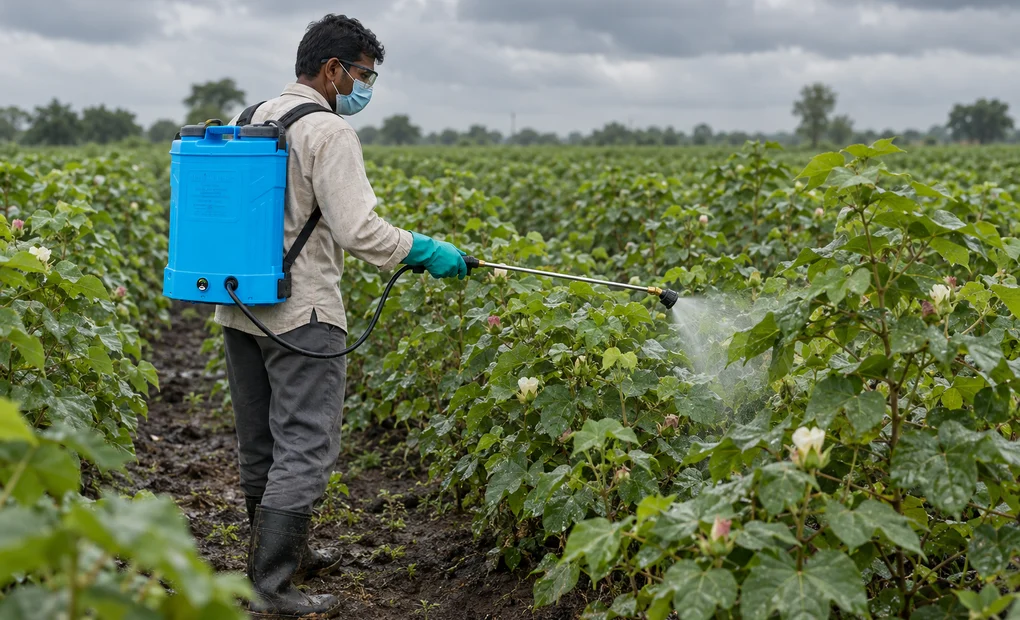
Kharif spraying happens in the hardest weather of the year. Rain can wash a spray off the leaves before it works, humid days bring disease, and by mid-season cotton is taller than the person spraying it. The right sprayer machine for agriculture in this season is the one that suits your crop, its height and the weather window you actually get.
This guide matches sprayers to the four main Kharif crops, cotton, paddy, soybean and groundnut, and covers the timing, technique, nozzle choice, safety and cleaning that make a spray count. It deals only with equipment and technique. For which product to use and at what dose, always follow the label and your local agriculture department or Krishi Vigyan Kendra.
Quick answer: which sprayer for which Kharif crop?
| Crop | Spraying challenge | Sprayer that fits | Nozzle |
|---|---|---|---|
| Cotton | Sucking pests under the leaves, plants grow tall | Battery or manual knapsack early, power sprayer or long-hose setup once the crop is tall | Hollow cone for pests |
| Paddy | Standing water, pests at the base of the plants | Battery or manual knapsack | Hollow cone, aimed at the base |
| Soybean | Large area, humid weather, flowering-stage pests and disease | Power sprayer for speed, knapsack for smaller plots | Hollow cone for pests, flat fan for herbicide |
| Groundnut | Leaf spot and rust on the lower leaves | Battery or manual knapsack | Hollow cone, reaching the underside of leaves |
The sections below explain each choice. All sprayer specifications come from the ALAP and MILAP range that Almighty Agrotech builds in Rajkot.
Why monsoon spraying is different
Three things change in the Kharif season: rain, wind and humidity. Plan around all three.
- Rain: the Directorate of Plant Protection, Quarantine and Storage advises that you do not spray just before rain or immediately after it, and that spraying should be done on a cool and calm day. Check the forecast before you mix a tank.
- Rain after spraying: the label tells you how rain-fast a product is. The FAO guidelines on ground application note that for most products, a shower two hours after treatment will not mean spraying again, but the label is the authority.
- Wind: the same FAO guidelines treat a light breeze of about 3 to 7 km/h, when leaves rustle and you feel wind on your face, as ideal. Do not spray in dead calm or very light air, and avoid herbicide spraying once the leaves are in constant motion.
- Direction: spray with the wind, never into it, so drift moves away from you.
- Time of day: spray in the morning or evening when it is cooler and calmer, as the ICAR soybean guidance recommends for insecticides.
- Humidity and disease: long spells of wet leaves raise disease risk. For soybean, humid weather that keeps leaves wet for three to four hours, plus night or morning fog, increases the chance of rust.
Spraying cotton in Kharif
In Bt cotton, bollworms are largely controlled by the crop itself, and sucking pests such as whitefly, jassid, aphid and mealybug do the most damage, according to researchers at Punjab Agricultural University. These pests feed on the underside of the leaves during both the vegetative and reproductive stages, which is exactly where a careless spray does not reach.
- Coverage: direct the spray up into the canopy so it reaches the underside of the leaves, not just the top surface.
- Spray volume: for sucking pests with a manual knapsack sprayer, the PAU researchers recommend 300 to 375 litres of spray solution per hectare, about 120 to 150 litres per acre. With a 16 litre tank, that is roughly 8 to 10 tank loads per acre.
- Crop height: knapsack sprayers suit crops up to about 1.5 metres tall. Once cotton grows past that, a lance held at shoulder height struggles to cover the whole plant.
- Sprayer choice: use a battery sprayer or manual knapsack sprayer while the crop is short. For a tall crop over a large area, a power sprayer with its 3 foot gun, or an HTP sprayer feeding two or three long hoses, saves walking and keeps pressure up.
Spraying paddy in Kharif
Paddy is sprayed standing in water, and some of its worst pests hide at the bottom of the plant. Brown planthopper nymphs and adults gather at the base of the plant just above the water, and heavy attack shows as circular dried patches known as hopper burn.
- Aim low: Tamil Nadu Agricultural University advises draining the water before spraying and directing the spray towards the base of the plants for brown planthopper.
- Sprayer choice: a battery or manual knapsack sprayer is the practical choice. You walk the bunds and rows, and a light machine is easier to carry through wet fields.
- Tank size: ALAP and MILAP battery sprayers hold 16 to 20 litres, and the MILAP ECO KPI-4 manual knapsack holds 20 litres, which means fewer trips back to refill across a wet field.
- Keep the lance steady: hold it low and sweep evenly between hills so the base of every plant gets covered.
Spraying soybean in Kharif
Soybean covers large areas quickly, so the spray volume you can manage in a day matters. The ICAR soybean extension bulletin gives clear equipment guidance.
- Spray volume: depending on crop stage, soybean needs about 500 litres of spray solution per hectare with a knapsack sprayer, or about 120 litres per hectare with a power sprayer. The bulletin warns that spraying with less will not give the desired results.
- What that means per acre: about 200 litres per acre with a knapsack, roughly 12 to 13 loads of a 16 litre tank, against about 50 litres per acre with a power sprayer, around 2 to 3 loads of a 20 litre tank.
- Sprayer choice: for a large soybean area, the bulletin names power and boom sprayers as suitable alternatives that cut the water, time and labour needed. For small plots, a battery or manual knapsack works if you keep to the full volume.
- Timing: spray insecticides in the morning or evening. The bulletin also advises not delaying needed insecticide sprays even during flowering, when caterpillars feed on flowers.
- Disease watch: rust tends to appear around flowering in humid weather, with spots mostly on the lower leaf surface, so coverage of the lower canopy matters.
Spraying groundnut in Kharif
Groundnut is a low, spreading crop, and its main diseases start on the leaves. According to Tamil Nadu Agricultural University, leaf spot begins to appear about a month after sowing and is severe during flowering and near harvest, while rust appears once the crop is over six weeks old, with orange pustules first on the lower surface of the leaves.
- Coverage: because rust starts on the underside of leaves, angle the nozzle so the spray reaches below the leaves, not only across the top.
- Sprayer choice: a battery sprayer or manual knapsack suits groundnut well. The crop is low, so reach is not a problem, and even walking pace gives even coverage.
- Timing: start watching the crop closely from about a month after sowing, when leaf spot can begin.
Which sprayer machine suits which job
| Sprayer type | Key specification | Best Kharif use |
|---|---|---|
| Manual knapsack | 16 to 20 L tank, hand pumped, no fuel or charging | Small plots, paddy, groundnut, spot spraying |
| Battery sprayer | 16 to 20 L tank, 100 to 110 PSI, 12 V battery | Paddy, groundnut, cotton and soybean on small to medium plots |
| Power sprayer | Petrol engine, 30 to 35 kg/cm², 10.5 L/min, 20 L tank on most models | Large soybean and cotton areas, taller crops |
| HTP sprayer | 22 or 30 L/min, 30 to 35 kg/cm², up to 100 m hose, 2 or 3 lines | Tall cotton over large areas, orchards, teams spraying together |
| Hi-Jet spray gun and lance | Brass guns and telescopic lances | Extra reach on power and HTP sprayers |
If spraying alone on vegetables or row crops is most of your work, our comparison of knapsack, foot and rocker sprayers and our guide to the best battery sprayer for agriculture go into more detail.
Nozzle and pressure for each crop
The nozzle decides whether the spray reaches the target. ICAR's soybean guidance finds the hollow cone nozzle best for insecticides because it spreads the spray evenly, and says herbicides should be sprayed only with a flat fan or flood jet nozzle.
- Pests and diseases in cotton, paddy, soybean and groundnut: hollow cone, for fine droplets that get into foliage and onto leaf undersides.
- Herbicides: flat fan or flood jet, for an even band across the ground.
- Tall plants and reach: an adjustable nozzle or a spray gun set to a narrower jet carries further.
- Pressure: too little pressure gives large drops and poor coverage, and too much makes fine mist that drifts. Keep a steady pumping rhythm on a manual sprayer, and use the pressure the machine is built for on battery and power sprayers.
Our guide to spray pump nozzle types explains every nozzle and where it works best.
Tall crops: when to move up to HTP
Once a crop outgrows a knapsack lance, or the area is too large to walk with a 16 litre tank, a higher-capacity setup pays off. An HTP sprayer stays on the ground beside a drum and pushes spray at 30 to 35 kg/cm² through hoses up to 100 metres long, so two or three people can spray at once. Pair it with a long brass gun or telescopic lance from the Hi-Jet spray gun and lance range for extra reach. Our HTP sprayer pump guide covers sizing and setup.
Safety and PPE during monsoon spraying
- Wear protection: gloves, a face mask, a cap, an apron and full-length trousers, as the Directorate of Plant Protection advises.
- Check the sprayer first: do not use a leaking or defective sprayer or the wrong nozzle.
- Never clear a nozzle by mouth: use a toothbrush tied to the sprayer instead.
- Spray with the wind: never walk into your own spray drift.
- Wash before eating: wash hands and face before eating, drinking or smoking.
- Follow the label: use only the product, dose and dilution recommended for your crop.
Cleaning the sprayer after spraying
Monsoon moisture and leftover spray solution corrode a sprayer fast. Clean it the same day, every time.
- Empty the tank: never leave spray solution standing in the sprayer.
- Wash with soap and water: wash the sprayer and buckets with clean water and detergent or soap.
- Flush the lines: pump clean water through the hose, lance and nozzle until it runs clear.
- Clean the nozzle and strainer: remove the nozzle tip and strainer and clean them with a soft brush.
- Check wear parts: look at seals, washers, strainers and nozzle tips, and replace any that are worn before the next spray.
- Dry and store: let the sprayer dry, then store it in a dry, covered place away from food and animal feed.
- Keep sprayers separate: use a separate sprayer for herbicides and for insecticides, so traces of one do not damage the crop you spray with the other.
Worn washers, nozzles and seals are available in our spare parts range.
Frequently asked questions
Which sprayer machine is best for agriculture in the Kharif season?
It depends on the crop. A battery or manual knapsack sprayer suits paddy, groundnut and small plots. A power sprayer suits large soybean and cotton areas because it needs far less water per hectare. For tall cotton over large areas, an HTP sprayer with long hoses lets two or three people spray at once.
Can I spray before rain in the monsoon?
No. The Directorate of Plant Protection, Quarantine and Storage advises not to spray just before rain or immediately after it. Spray on a cool, calm day and check the product label for rain-fastness. FAO guidance notes that for most products, a shower two hours after spraying will not mean re-spraying.
How much spray solution does soybean need per acre?
ICAR guidance puts soybean at about 500 litres per hectare with a knapsack sprayer, roughly 200 litres per acre, or about 120 litres per hectare with a power sprayer, roughly 50 litres per acre. Spraying with less water will not give the desired results.
How should I spray paddy for brown planthopper?
Brown planthoppers gather at the base of the plant just above the water. Tamil Nadu Agricultural University advises draining the water before spraying and directing the spray towards the base of the plants, rather than over the top of the crop.
What is the best time of day to spray crops?
Morning or evening, when it is cooler and the wind is light. Avoid hot sun, strong wind and dead calm. A light breeze that you can feel on your face and that rustles the leaves is ideal, and always spray with the wind, not into it.
Which nozzle should I use for Kharif crops?
Use a hollow cone nozzle for insecticides and fungicides, because it spreads fine droplets evenly into the foliage. Use a flat fan or flood jet nozzle for herbicides. For tall crops, an adjustable nozzle or spray gun set to a narrower jet gives more reach.
How do I clean a sprayer after spraying?
Empty the tank the same day, wash the sprayer and buckets with clean water and soap, flush clean water through the hose and nozzle, clean the nozzle tip and strainer, replace worn seals and washers, then dry and store the sprayer in a covered place.
Ready for the season? Compare battery sprayers, power sprayers and manual sprayers with current prices, or contact our team to choose the right sprayer for your crop and farm size.
- 1. Quick answer: which sprayer for which Kharif crop?
- 2. Why monsoon spraying is different
- 3. Spraying cotton in Kharif
- 4. Spraying paddy in Kharif
- 5. Spraying soybean in Kharif
- 6. Spraying groundnut in Kharif
- 7. Which sprayer machine suits which job
- 8. Nozzle and pressure for each crop
- 9. Tall crops: when to move up to HTP
- 10. Safety and PPE during monsoon spraying
- 11. Cleaning the sprayer after spraying
- 12. Frequently asked questions


