22 August 2026
Power Weeder Attachments: Complete Guide for 7HP and Mini Weeders
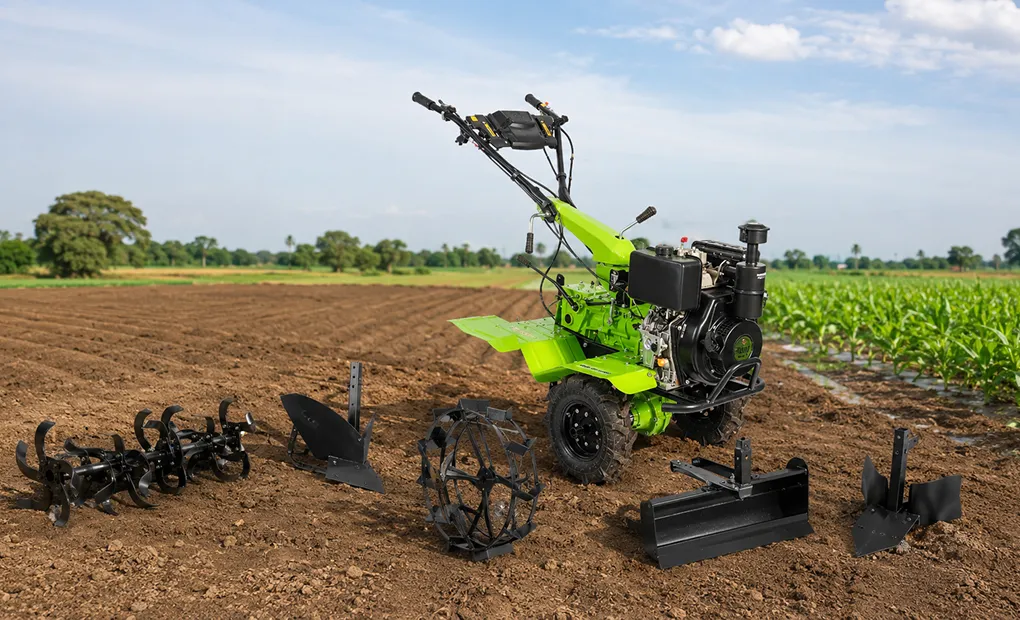
Most farmers buy a power weeder for one job. Then they discover the machine sitting idle for ten months of the year while they hire a tractor for ridging and a separate pump for spraying.
The attachments are what fix that. The same machine that turns your rotary can pull a plough, cut a drainage channel, grip a puddled paddy field or carry a boom sprayer. You are not buying a new machine. You are buying a fitting.
This guide covers every power weeder attachment in the ALAP range: what each one does, which crop and soil it suits, and the one specification you must check before ordering anything. If you are still choosing the machine itself, start with our complete power weeder guide instead, then come back here.
Power weeder attachment list
|
Attachment |
Main job |
Shaft size |
Best suited for |
|
Tilling blade |
Primary soil breaking and tilling |
23mm and 33mm |
All field prep |
|
Hook blade |
Cutting and clearing in harder ground |
33mm |
Heavy or compacted land |
|
Soil lifting blade |
Turning and lifting soil |
23mm and 33mm |
Loosening before sowing |
|
3 tines cultivator |
Light inter row cultivation |
23mm and 33mm |
Narrow row crops |
|
5 tines cultivator |
Wider inter row cultivation |
23mm and 33mm |
Wider row spacing |
|
Ridger |
Making ridges and furrows |
23mm and 33mm |
Sugarcane, potato, vegetables |
|
Plough |
Turning and preparing soil |
23mm and 33mm |
Primary tillage |
|
Ditching blade |
Cutting drainage channels |
23mm and 33mm |
Field drainage, irrigation lines |
|
Cage wheel |
Traction in wet or soft soil |
23mm and 33mm |
Paddy fields, wet land |
|
Weeding wheel |
Weed clearing between rows |
23mm and 33mm |
Standing crop weeding |
|
Tyres (4 x 8) |
Transport and dry field work |
Standard |
Moving between plots |
|
Wheel shaft tube |
Supports wheel fitment |
Per shaft size |
Fitting wheels and cages |
|
HTP base |
Mounts spraying equipment on the weeder |
Standard |
Converting to a sprayer |
|
Boom sprayer |
Wider coverage spot spraying |
With HTP base |
Field crops |
Check your shaft size first
This is the part people skip, and it is the reason attachments come back to the shop unopened.
Almighty power weeder attachments come in 23mm and 33mm shaft sizes. These are not interchangeable. A 33mm hook blade will not go onto a 23mm shaft, and a 23mm cage wheel will spin loose on a 33mm one.
Before you order anything:
1. Look at the output shaft on your weeder, the one the rotary blades mount onto.
2. Measure its diameter, or check the model plate.
3. If you cannot measure it, photograph the shaft and the model plate together and send both.
Smaller mini weeders generally run the 23mm shaft. Larger machines generally run 33mm. Do not assume based on HP alone. Confirm the shaft on your own machine, because the same power rating can appear on different builds.
The hook blade is currently supplied for the 33mm shaft only. Cage wheels and weeding wheels come in both sizes, so state which one you need when ordering. Everything else in the main range fits both.
Soil working attachments
Tilling blade
The default working tool. Curved blades that cut and break soil as the rotor turns, leaving a seedbed ready for sowing. This is the attachment most weeders arrive with, and the one that wears fastest because it does the most work.
Blade counts differ by machine. The APW-100PB runs 32 blades in a 16 plus 16 arrangement and tills a width of 500 to 1000 mm. The smaller MPW-50P runs 18 blades, 9 plus 9, across 400 to 530 mm. Both work to a depth of 100 to 250 mm.
Blades wear from the tip inward. When the cutting edge has rounded off and the machine starts riding on top of the soil instead of biting into it, the blade set needs replacing rather than sharpening.
Hook blade
Made for cutting and clearing where a standard tilling blade skids. Useful on land that has not been worked for a season, or in black cotton soil after it has dried and set hard. Supplied for 33mm shafts only.
Soil lifting blade
Lifts and turns soil rather than chopping it fine. Good before sowing when you want loose, aerated soil without pulverising it into dust. Fine soil looks impressive but crusts hard after the first rain, so a coarser finish often holds up better.
3 tines and 5 tines cultivator
Cultivators work between crop rows once the crop is standing. Tines break the crust, cut small weeds and let water in.
Pick by your row spacing, not by preference. The 3 tine unit fits narrower rows where you have limited clearance. The 5 tine covers more ground per pass and suits wider spacing. Running a 5 tine in narrow rows means clipping the crop, and no amount of careful driving fixes that.
Ridging and channel attachments
Ridger
Forms ridges and furrows in one pass. Used for sugarcane, potato, groundnut and most vegetables grown on beds. The ridge lifts the root zone clear of standing water and the furrow carries irrigation.
Doing this with a power weeder instead of hiring a tractor is where many farmers recover the cost of the machine, especially on plots under three acres where a tractor is awkward and expensive to bring in.
Plough
For turning and preparing soil more deeply than a rotary manages. Used for primary tillage, working previous crop residue into the soil, and opening land that has been left fallow.
Ditching blade
Cuts drainage channels and irrigation lines. Underrated in the Kharif season. Water sitting in a field for two days after heavy rain does more damage to a standing crop than most farmers account for, and cutting a drainage line quickly with a weeder is far faster than doing it with labour.
Wheels and traction attachments
Cage wheel
Open steel cage wheels that improve traction in wet or soft soil where rubber tyres sink and spin. Standard fitment for paddy field work. The open design also sheds mud instead of packing it, so you keep grip through the pass. Available in both 23mm and 33mm.
Weeding wheel
Handles weed clearing between rows. Cuts and buries small weeds while keeping the crop line intact. Also available in both shaft sizes.
Tyres (4 x 8)
Pneumatic tyres for transport between plots and for dry field work where cage wheels are unnecessary. This is the standard tyre size on machines like the APW-100PB, so the same part serves as a replacement as well as a swap. Most farmers keep both tyres and cages, and change by season.
Wheel shaft tube
A supporting component for wheel fitment. Order it matched to your shaft size.
Spraying attachments
Yes, a power weeder can be used for spraying. Two parts make it possible.
The HTP base mounts spraying equipment onto the power weeder, so the machine carries the pump instead of you carrying a tank. The boom sprayer then gives wider coverage spot spraying across the crop rather than one nozzle at a time.
For anyone farming more than a couple of acres, this changes the arithmetic on spraying. A knapsack sprayer covers a fixed area per tank and per hour of walking. A boom covers a multiple of that with the same operator.
Order the HTP base and boom together, and confirm which HTP pump size your machine takes and how the pump is driven before you buy, since this varies by model. Send your model number on WhatsApp and we will confirm the full setup. If you want to understand the pump side first, our spray pump spare parts guide explains how HTP pumps are built and which parts wear.
Which attachments fit ALAP power weeder models
The current range includes ALAP models APW-100PB, APW-105P, APW-105DEA and APW-105DM-1 back rotary, plus MILAP models MPW-50P and MPW-100P. All are ISI certified and FMTTI tested.
The machines vary widely in size, which is why fitment matters. The MPW-50P is a 3 HP mini weeder with a 99cc petrol engine tilling 400 to 530 mm. The APW-100PB runs a 212cc, 4.2 kW four stroke petrol engine with a gear drive and tills 500 to 1000 mm. Those two machines pull very different loads.
Two rules cover almost every case:
1. Match the shaft size. 23mm attachments to 23mm shafts, 33mm to 33mm.
2. Match the power to the load. Ridging, ploughing and ditching pull far harder than light cultivation. Heavier work belongs on the larger machines in the range.
Current prices and full specifications for each model sit on the individual product pages under power weeders. For attachment fitment, send your model number on WhatsApp and we will confirm before you order.
Maintenance of the power weeder attachments
Attachments are simple, so maintenance is mostly discipline rather than skill.
1. Clean after every use. Soil left on blades holds moisture and rusts them. This matters most with cage wheels, where dried mud inside the cage adds weight and throws the balance off.
2. Check bolts before each session. Rotary work vibrates fasteners loose. A blade that comes off at working speed is dangerous.
3. Grease the shaft before fitting. It stops seizing and makes the next change easy. Attachments that sit rusted on a shaft for a season usually need cutting off.
4. Store dry and off the floor. A wooden pallet in the shed is enough.
5. Replace blades as a set. Fitting one new blade among worn ones puts the rotor out of balance and stresses the bearings.
Blades, bolts and fasteners are stocked as spare parts through the dealer network.
What decides the power weeder attachments price
Attachment prices move with a few things: the size and steel grade, the shaft size, and whether it is a single tool or an assembly like the boom sprayer and HTP base.
As a rough order, blades and tines sit at the lower end, wheels and cages in the middle, and the boom sprayer and HTP base at the top because they include mounting hardware.
Rates change with steel prices, so we do not publish a fixed attachment list. Call or WhatsApp with your model number and the attachments you want, and you will get the current rate the same day.
Get the right power weeder attachment the first time
Check your shaft size, note your model number, and pick the attachment for the job you actually do most often. That covers 90 percent of the decision.
.
Almighty Agrotech has manufactured farm machinery in Rajkot since 1977. ISI marked, FMTTI certified, Made in India, and backed by over 3,000 dealers and 1 crore plus customers.
Call 02827-287307 or WhatsApp your model number to +91 99097 88770 for attachment prices and fitment.
Browse the full power weeder attachment range, read what a power weeder is and how it works, or find your nearest dealer on our contact page.
Frequently Ask Questions
What attachments can be fitted to a power weeder?
Tilling blade, hook blade, soil lifting blade, 3 and 5 tine cultivators, ridger, plough, ditching blade, cage wheel, weeding wheel, tyres, wheel shaft tube, and an HTP base with boom sprayer. In practice a single machine can handle tillage, ridging, weeding and spraying.
Can a power weeder be used for spraying?
Yes. The HTP base mounts spraying equipment onto the power weeder, and the boom sprayer gives wider coverage spot spraying. Confirm which pump size suits your model and how it is driven before ordering, because this differs across the range.
Are power weeder attachments and power tiller attachments the same thing?
Mostly yes. Farmers use both names for the same machine, and Almighty attachments are listed under both. What matters is the shaft size and the machine's power, not which word your dealer uses.
How do I know if I need a 23mm or 33mm attachment?
Measure the output shaft on your weeder where the blades mount. Smaller mini weeders usually take 23mm and larger machines usually take 33mm, but confirm on your own machine rather than assuming from HP. Send a photo of the shaft and model plate if you are unsure.
Which attachment should a first time buyer get?
Beyond the tilling blade the machine comes with, most farmers get the most out of a ridger and a cage wheel set. The ridger replaces hired tractor work on small plots and the cage wheels make the machine usable in wet conditions. Add the cultivator once you know your row spacing.
Can I use the same attachments on a 3 HP mini weeder and a larger machine?
Only if the shaft size matches, and only for lighter work. A 3 HP machine like the MPW-50P tills a narrower width and has less power to pull a ridger or plough through heavy soil. Buying an attachment the machine cannot pull wastes money and strains the gearbox.
Do attachments from other brands fit ALAP power weeders?
Sometimes physically, rarely well. Shaft diameter, mounting hole pattern and clearances are built to model specifications. A part that is close but not correct wears the shaft and can damage the gearbox, which costs far more than the attachment saved.
- 1. Power weeder attachment list
- 2. Check your shaft size first
- 3. Soil working attachments
- 4. Ridging and channel attachments
- 5. Wheels and traction attachments
- 6. Spraying attachments
- 7. Which attachments fit ALAP power weeder models
- 8. Maintenance of the power weeder attachments
- 9. What decides the power weeder attachments price
- 10. Get the right power weeder attachment the first time
- 11. Frequently Ask Questions
Need help choosing the right power weeder attachments for your farm? Send your details and our team will get back to you with prices and your nearest dealer.
View the Power Weeder Attachments range →


