17 August 2026
What Is a Power Weeder? Types, Parts and Uses
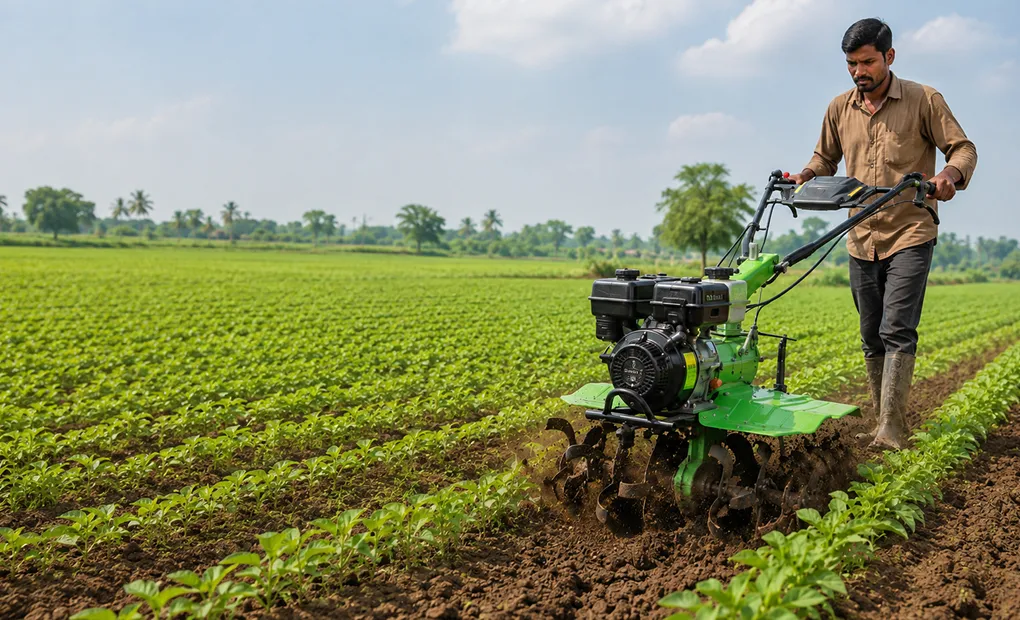
If weeding still eats up most of your labour budget every kharif season, a power weeder is the machine people usually mean when they ask how to cut that cost. The trouble is that the name gets used loosely. Plenty of buyers ask for a power weeder when they actually need a power tiller, or the other way round, and the wrong choice wastes money. Before the monsoon weeds take over your rows, here is what a power weeder is, how it works, how it differs from a power tiller and a cultivator, the types sold in India, and the jobs it is built for.
Already know you need one? Compare every model on our power weeder machine price list.
What is a power weeder, and how does it work?
A power weeder is a small, walk-behind farm machine that removes weeds and loosens the top layer of soil between crop rows. A petrol or diesel engine sits on top of the frame and drives a rotating shaft fitted with curved steel blades, usually called rotary tines. As the blades spin, they slice standing weeds at the root and turn over the top two to four inches of soil, which also lets air and water reach the crop. The operator walks behind, holding a handlebar fitted with a throttle and clutch, and steers the machine down the row.
That is the whole idea: instead of a labourer bending over a khurpi for hours, one person walks the machine through the field and clears several times the area in the same time. Because the working width is narrow, a power weeder fits between rows of standing crops where a tractor cannot go. This puts it in the family of mechanical weed control tools, with an engine doing the hard part.
Types of power weeders used in India
Power weeders are grouped a few different ways, and knowing the split helps you match a machine to your field.
Front rotary weeders
The blades sit in front of the engine and wheels. These are lighter, easier to turn at the headland, and the common choice for open field weeding and smaller plots.
Back rotary weeders
The blades sit behind the operator, so the wheels pass over the row first and the soil is worked last, leaving a cleaner finish. A back rotary machine is heavier and costs more, but it suits standing row crops and wider spacings.
Mini power weeders
Compact 1 to 3 HP machines meant for kitchen gardens, polyhouses, nurseries, and vegetable beds where a full-size unit is too big.
Petrol and diesel variants
Petrol engines start easily and run quieter, which many small growers prefer. Diesel engines cost more upfront but are cheaper to run over long hours, so they suit larger holdings. Battery models exist for very light work, though engine machines still do most field weeding.
Almighty Agro builds both brands across this range, from the compact MILAP units to the ALAP back rotary machines. You can see the current ALAP and MILAP power weeder range on the product page, and if you want models compared with pricing, the complete guide to power weeder models and prices covers that side in detail.
The main parts of a power weeder
Knowing the parts makes buying, servicing, and ordering spares far easier. A typical power weeder has:
Engine
The petrol or diesel motor that powers everything, rated in horsepower. Most field machines fall in the 5 to 9 HP band.
Transmission and gearbox
Transfers engine power to the rotary shaft and controls speed.
Rotary blades or tines
The L-shaped or curved steel blades that do the cutting and digging. These wear out over time and are the part farmers replace most often.
Handlebar with clutch and throttle
The control station the operator holds, used to steer, set engine speed, and engage the blades.
Wheels
Rubber wheels for transport, or cage or iron wheels for grip in wet and soft soil.
Attachment coupling
The mount that lets you swap in other tools. A single power weeder attachment setup can turn the machine into a ridger, furrow opener, plough, cultivator, water pump, or reaper.
Power weeder vs power tiller vs cultivator: what is the difference?
This is the question that trips up most first-time buyers, so it is worth being plain about it.
A power weeder is the lightest of the three. It is a small walk-behind machine, usually 1 to 10 HP, built mainly for inter-row weeding and shallow soil work, and it slots into narrow gaps between standing crops.
A power tiller, also called a two-wheel tractor, is bigger and heavier, often 8 to 15 HP or more. It is a primary tillage machine that ploughs, puddles paddy fields, and can pull a trailer. It is not made to weed neatly between close rows.
A cultivator is usually an implement, not a machine on its own. Tractor-mounted cultivators use tines for secondary tillage and weeding across an open field, while a hand cultivator is manual. In short: a power weeder weeds between rows, a power tiller does heavy tillage, and a cultivator does broad-field secondary tillage behind a tractor.
What a power weeder is used for?
Weeding is the headline job, but the machine does more. With the rotary blades on, it clears weeds and aerates soil in cotton, sugarcane, maize, chilli, groundnut, pulses, and vegetable rows, and it works well in orchards and between tea and coffee bushes. Mixing organic manure into the topsoil is a common second use. Swap the blades for attachments and the same engine makes furrows and ridges, does light ploughing, opens irrigation channels, and even runs a water pump or reaper. On small and medium holdings, where weeding labour is costly and hard to find, that flexibility is the case for owning one.
What to check before you choose one?
- Match the horsepower to your field size and soil, since a heavier machine tires the operator on a small plot and a light one struggles in hard ground.
- Pick front rotary for open weeding and back rotary for standing row crops.
- Choose petrol for lighter, occasional use and diesel for long daily hours.
- Check blade quality.
- Check how easily spare tines and a service centre are available near you, because a machine is only as useful as the parts and support behind it.
- The maker matters too: Almighty Agro is a Rajkot manufacturer run by the Bhalani family since 1977, its ALAP and MILAP power weeders are FMTTI certified, and it backs them with an in-house testing lab and dealers across India.
If you are timing a purchase, the pre-monsoon farm equipment checklist helps, and for grass and bush clearing see the brush cutter buying guide.
A power weeder is a simple machine once you see it clearly: an engine, a set of rotary blades, and a handlebar, built to do between the rows what a tractor cannot. Get the type and horsepower right for your crop, keep spare blades on hand, and it pays back the labour it saves within a season or two.
Frequently asked questions
What is the difference between a power weeder and a power tiller?
A power weeder is a light walk-behind machine, usually 1 to 10 HP, built for weeding and shallow soil work between crop rows. A power tiller is larger and heavier, made for ploughing and primary tillage, and can pull a trailer. If your main job is weeding between standing crops, you want a power weeder.
What are the main types of power weeders?
The main split is front rotary versus back rotary, then by engine type as petrol or diesel, and by size from mini units of 1 to 3 HP up to field machines of 5 to 9 HP and above. Front rotary suits open field weeding, while back rotary gives a cleaner finish in standing row crops.
What can a power weeder be used for besides weeding?
With attachments, the same machine makes ridges and furrows, does light ploughing, opens irrigation channels, mixes organic manure, and can run a water pump or reaper. The attachment set is often the most useful thing you buy after the machine itself.
Which power weeder is best for a small farm?
For a small holding, a mini or a mid 5 to 7 HP machine usually fits best, since it is easy to handle and cheap to run. Match the horsepower to your soil and row spacing, and check that spare blades and service are available nearby before buying.
Is there a government subsidy on power weeders?
Several state agriculture departments and central farm mechanisation schemes do offer subsidy on power weeders, but the rate and eligibility change by state and year. Check your state agriculture portal or ask an authorised dealer for the current scheme before you buy.
Related: when something on the machine wears out, our power weeder spare parts name list names every part, with a labelled diagram and the ALAP part codes.
- 1. What is a power weeder, and how does it work?
- 2. Types of power weeders used in India
- 3. The main parts of a power weeder
- 4. Power weeder vs power tiller vs cultivator: what is the difference?
- 5. What a power weeder is used for?
- 6. What to check before you choose one?
- 7. Frequently asked questions
Need help choosing the right power weeder for your farm? Send your details and our team will get back to you with prices and your nearest dealer.
View the Power Weeder range →


